Who Was Huang Tingjian? Master of Poetry & Wild Cursive
Founder of the Jiangxi Poetry School, pillar of the Su Shi literary circle, and one of the Four Masters of Song Dynasty calligraphy
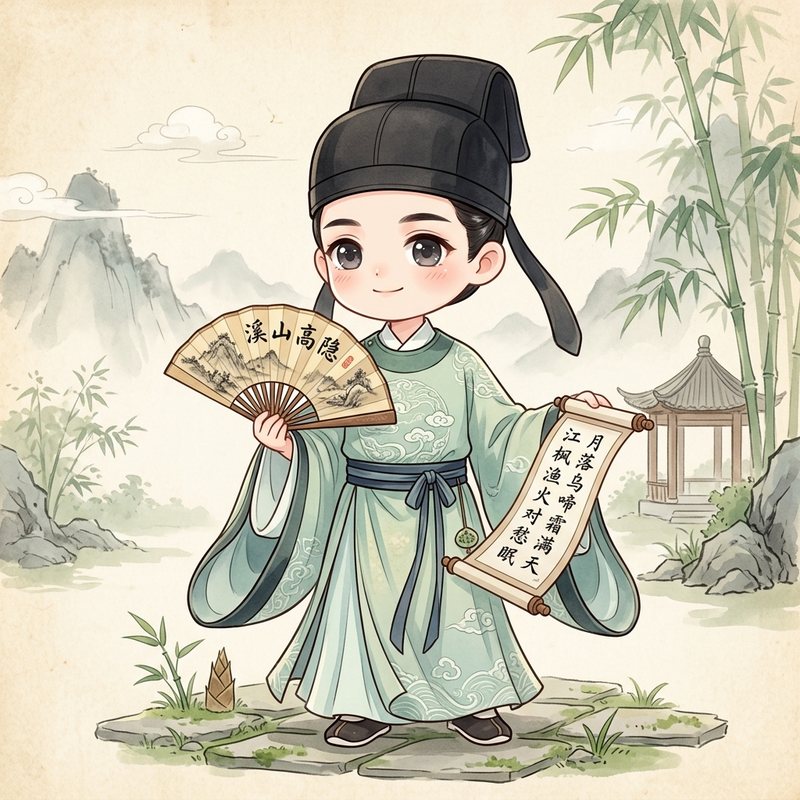
Huang Tingjian (黄庭坚 · Huáng Tíngjiān)
字鲁直 · 号山谷道人/涪翁
Founder of the Jiangxi Poetry School, chief of the Four Scholars of the Su Gate, and titan of Song wild cursive calligraphy.
江西诗派开山宗师,苏门四学士之首,宋四家书法泰斗;以‘点铁成金’与‘长枪大戟’狂草名垂千古。
- Founder of the Jiangxi Poetry School: Established China's first formally codified poetic lineage, championing meticulous syntax ('jufa') and transmuting classical heritage into bold intellectual verse.
- One of the Four Masters of Song Calligraphy: Celebrated alongside Su Shi, Mi Fu, and Cai Xiang ('Su-Huang-Mi-Cai'), revolutionizing wild cursive calligraphy into dynamic abstract rhythm.
- Leader of the Four Scholars of the Su Gate: The closest intellectual peer and devoted friend of Su Shi, immortalized in cultural history as the dual titans 'Su and Huang'.
- Fearless Historian & Moral Exemplar: Suffered a decade of exile for refusing to falsify official imperial records, while universally honored in the 'Twenty-Four Filial Exemplars' for washing his mother's chamber pot.
Phase 1: Scholarly Roots, Uncle's Mentorship & Imperial Examination Triumph (1045–1071)
Huang Tingjian was born in 1045 CE into an illustrious scholarly family in Shuangjing Village, Fenning, Hongzhou (modern Xiushui County, Jiujiang, Jiangxi Province). His father, Huang Shu, was an esteemed Jinshi scholar of the Qingli era. Blessed with exceptional intellect and photographic memory, young Tingjian absorbed classical Confucian education at home from an early age.
宋仁宗庆历五年(1045年),黄庭坚出生于洪州分宁双井村的书香世家。其父黄庶为庆历二年进士,学识渊博。黄庭坚自幼天资卓绝,过目不忘,幼承庭训,深受儒学正统家风熏陶。
Following the early death of his father, Huang Tingjian traveled with his maternal uncle Li Chang, a celebrated bibliophile and imperial scholar-official, to Yexian in Ruzhou (modern Pingdingshan, Henan). Surrounded by Uncle Li's vast private library of classical scrolls, Huang buried himself in historical texts, mastering ancient philology and poetic prosody.
早年丧父后,黄庭坚随舅父李常(著名藏书家、学者)游学于汝州叶县。李常藏书万卷,黄庭坚在此博览经史百家,刻苦研习古文诗律,打下了极其扎实的文学与学术功底。
In 1067 CE, at the age of twenty-two, Huang Tingjian journeyed to the Song imperial capital of Kaifeng and successfully passed the prestigious Jinshi civil service examinations. Appointed as an imperial sheriff (Weiguan) in Yexian, he stepped onto the national political stage with integrity and a deep concern for the common folk.
宋英宗治平四年(1067年),年仅二十二岁的黄庭坚进京应试,一举登进士第。初授汝州叶县尉,其后踏上大宋仕途,以廉洁刚正、体恤民瘼深得百姓爱戴。
春风得意马蹄疾,金榜题名步青云。
Chūn fēng dé yì mǎ tí jí, jīn bǎng tí míng bù qīng yún.
The spring breeze carries joyous hooves as his name is inscribed on the golden imperial register, stepping into civil prominence.
Context · Commemorating Huang Tingjian's youthful success in the imperial examinations at Kaifeng, marking the dawn of his official and literary destiny.
Phase 2: Academic Office in Daming, Magistrate at Taihe & Poetic Breakthrough (1072–1085)
In 1072 CE, Huang was appointed professor at the Northern Capital Imperial Academy (Guozijian) in Daming (modern Handan, Hebei). Over seven years of teaching, his fame as a scholar grew across northern China. During this period, he sent poetic samples to literary titan Su Shi. Reading Huang's verse, Su exclaimed that his prose was 'vast and serene, echoing with profound undertones,' marking the birth of their lifelong brotherhood.
熙宁五年(1072年),黄庭坚出任北京国子监教授,任职七载,以严谨学风名噪黄河之北。在此期间他致书文坛领袖苏轼,苏轼见其诗文击节赞赏,叹为‘汪洋冲澹,有一唱三叹之声’,开启了二人跨越一生的知己之谊。
In 1080 CE, Huang was named magistrate of Taihe County in Jizhou (modern Ji'an, Jiangxi). He governed with profound empathy, reducing onerous local tax burdens and defending peasants against corrupt officials. In his leisure hours, he built Kuaige Pavilion beside the Gan River. Gazing across the autumn moonlight, he composed his immortal masterpiece 'Ascending Kuaige Pavilion'.
元丰三年(1080年),黄庭坚知吉州太和县。他勤政爱民,轻徭薄赋,深受太和百姓爱戴。公务之余,他在澄江之畔建快阁,登临凭虚,写下了千古绝唱《登快阁》。
落木千山天远大,澄江一道月分明。
Luò mù qiān shān tiān yuǎn dà, chéng jiāng yī dào yuè fēn míng.
Across a thousand hills stripped leaves leave the heavens vast and high; along a clear singular river the moon shines crisp and bright.
Context · From Huang Tingjian's seven-character regulated verse 'Ascending Kuaige Pavilion' (登快阁), synthesizing profound cosmic space with transcendental philosophical equanimity.
Later transferred to oversee a small customs and liquor tax station in Deping Town, Dezhou (modern Linyi, Shandong), Huang lived in frugal quietude. While sitting by the lamp on a rainy night, longing for his childhood friend Huang Jifu in faraway Guangdong, he wrote the defining couplet of Song poetics: 'A cup of wine amid peach and plum blossoms in the spring breeze; ten years of night rain by lonely lamps adrift on lakes and rivers.'
元丰七年(1084年),黄庭坚改监德州德平镇。在清苦平淡的微官岁月中,他深夜对灯怀念远在广东的同窗挚友黄几复,写下了惊艳千古的《寄黄几复》:‘桃李春风一杯酒,江湖夜雨十年灯’。
桃李春风一杯酒,江湖夜雨十年灯。
Táo lǐ chūn fēng yī bēi jiǔ, jiāng hú yè yǔ shí nián dēng.
A cup of wine amid peach and plum blossoms in the spring breeze; ten years of night rain by lonely lamps adrift on lakes and rivers.
Context · Written in 1085 to Huang Jifu, this peerless couplet juxtaposes youth's joyful gathering with a decade of solitary wandering through pure imagistic resonance.
Phase 3: Imperial Annals, Factional Persecution & The Southwest Exiles (1086–1105)
With the accession of Emperor Zhezong and the rise of the Yuanyou administration in 1086 CE, Huang Tingjian was summoned back to Kaifeng. He served as collator in the imperial library and senior compiler of the 'Veritable Records of Emperor Shenzong' (神宗实录). Alongside Su Shi, Qin Guan, Chao Buzhi, and Zhang Lei, he formed the celebrated 'Four Scholars of the Su Gate,' dominating the capital's cultural golden age.
元祐元年(1086年),哲宗即位,旧党当政。黄庭坚被召入京,任秘书省校书郎、《神宗实录》检讨官。他与苏轼、秦观、晁补之、张耒并称‘苏门四学士’,文采风流倾动京华,其书法亦跻身‘宋四家’之列。
When the rival political faction regained power in 1094 CE, the compilers of the imperial records were viciously purged. Accused of 'slandering' the previous reign, Huang was demoted to assistant prefect of Fuzhou and exiled to Qianzhou in modern Chongqing. Embracing Chan Buddhist meditation and calling himself 'The Mountain Valley Daoist' and 'Fu Weng', he channeled his inner storms into wild cursive calligraphy, producing world-historic treasures like 'Biographies of Lian Po and Lin Xiangru'.
绍圣元年(1094年),新党执柄,大肆清算元祐官员。黄庭坚因修撰《神宗实录》直笔秉公,被诬告‘多诬’,贬为涪州别驾,安置黔州。在川黔蛮荒烟雨中,他自号‘山谷道人’与‘涪翁’,参禅悟道,狂草书法脱胎换骨,臻于化境。
In 1104 CE, during the reign of Emperor Huizong, Huang's name was carved onto the infamous 'Yuanyou Partisans Stele,' and he was exiled even further south to Yizhou (modern Hechi, Guangxi). Denied civil lodgings by a subservient local prefect, the venerable master made his home atop the drafty southern city gatehouse. In autumn 1105 CE, serene and free of resentment, Huang Tingjian passed away peacefully at the age of sixty.
崇宁三年(1104年),徽宗立元祐党籍碑,黄庭坚遭削籍编管宜州。知州谄媚蔡京,禁民租房,黄庭坚遂坦然寄寓于宜州南门城楼之上,处之泰然。崇宁四年九月三十日,这位一代文宗在城楼微风中安详辞世,享年六十岁。
平生个里愿杯深,去国十年老尽少年心。
Píng shēng gè lǐ yuàn bēi shēn, qù guó shí nián lǎo jìn shào nián xīn.
All my life my wish was for deep brimmed wine; ten years cast out from the court have aged away all youthful ambition.
Context · From Huang Tingjian's heartbreakingly serene lyric 'Yu Meiren' composed in Yizhou, embracing exile with tranquil detachment.
| Perspective 视角 | Huang Tingjian (The Poetic Alchemist) | John Donne (The Metaphysical Innovator) |
|---|---|---|
| Poetic Revolution | Founded the Jiangxi Poetry School; formulated 'turning iron into gold' and 'transmuting bones and essence' to renew traditional verse. | Pioneered English Metaphysical Poetry; replaced Elizabethan melodic sweetness with gritty colloquial rhythms and complex conceits. |
| Intellectual Craft & Syntax | Emphasized 'jufa' (syntactic architecture), dense classical allusions, and surprising juxtapositions to provoke deep contemplation. | Employed elaborate metaphysical conceits, paradoxes, and striking analytical analogies between physical and spiritual worlds. |
| Reverence for Masters | Canonized Tang master Du Fu as the ultimate benchmark of poetic art, studying his syntactic structure to create innovative Song poetry. | Synthesized classical rhetoric with contemporary Renaissance science, theology, and philosophy into radical personal expression. |
| Enduring Legacy | Shaped centuries of Chinese literary criticism; celebrated as one of the Four Masters of Song Calligraphy and a paradigm of filial virtue. | Rediscovered by 20th-century Modernists like T.S. Eliot as a monumental master of poetic wit, emotional intensity, and intellect. |
Trace Huang Tingjian's Footsteps on the Interactive Topographic Map
Follow his actual historical trail across 9 Song Dynasty stations—from childhood in Fenning and triumphs in Kaifeng to magistrate duties in Taihe and exiles in Qianzhou and Yizhou.
Launch Interactive Journey MapFrequently Asked Questions (FAQ)
Who was Huang Tingjian in Chinese cultural history?
Huang Tingjian (1045–1105) was an eminent Northern Song Dynasty poet, scholar, and calligrapher. He founded the influential Jiangxi Poetry School, belonged to the renowned Four Scholars of the Su Gate under Su Shi, and was celebrated as one of the Four Masters of Song Dynasty calligraphy alongside Su, Mi Fu, and Cai Xiang.
What is the Jiangxi Poetry School founded by Huang Tingjian?
The Jiangxi Poetry School was China's first formally recognized stylistic poetic lineage. Pioneered by Huang Tingjian and inspired by Du Fu, it rejected shallow ornamental verse in favor of rigorous textual craft, inventive syntactic phrasing ('jufa'), allusive layering, and transforming everyday raw language into poetic gold ('turning iron into gold').
Why is Huang Tingjian compared to English poet John Donne?
Both Huang Tingjian and John Donne revolutionized poetry by replacing superficial lyrical sweetness with intellectual rigor, complex metaphysical conceits, and striking syntactic tension. Rather than relying on effortless melodious flow, each poet demanded active erudition from readers, combining profound scholarly meditation, startling metaphors, and uncompromising structural discipline.
What is Huang Tingjian's greatest contribution to Chinese calligraphy?
Huang Tingjian stands among the Four Masters of the Song Dynasty ('Song Si Jia'). He pioneered an expressive, architectural regular script and attained the pinnacle of wild cursive calligraphy. His monumental handscroll 'Biographies of Lian Po and Lin Xiangru' transformed brush calligraphy into dynamic, rhythmic, and emotive abstract art.
Why was Huang Tingjian exiled to Qianzhou and Yizhou?
As chief editorial compiler of the 'Veritable Records of Emperor Shenzong' during the Yuanyou era, Huang Tingjian insisted on historical truthfulness. When opposing political factions regained power during the Shaosheng era, they accused his chronicles of slander, banishing him first to southwestern Qianzhou and later to remote subtropical Yizhou.
What is the story of Huang Tingjian and the Twenty-Four Filial Exemplars?
Despite attaining elite ministerial status in the imperial capital, Huang Tingjian personally washed his mother's chamber pot every morning and tended her with humble devotion. His steadfast refusal to delegate intimate filial duties to servants earned him inclusion in China's classic canon, the 'Twenty-Four Filial Exemplars'.
Walk with Huang Tingjian Across China
随黄庭坚漫步华夏河山 · 亲历命运逆境与精神涅槃