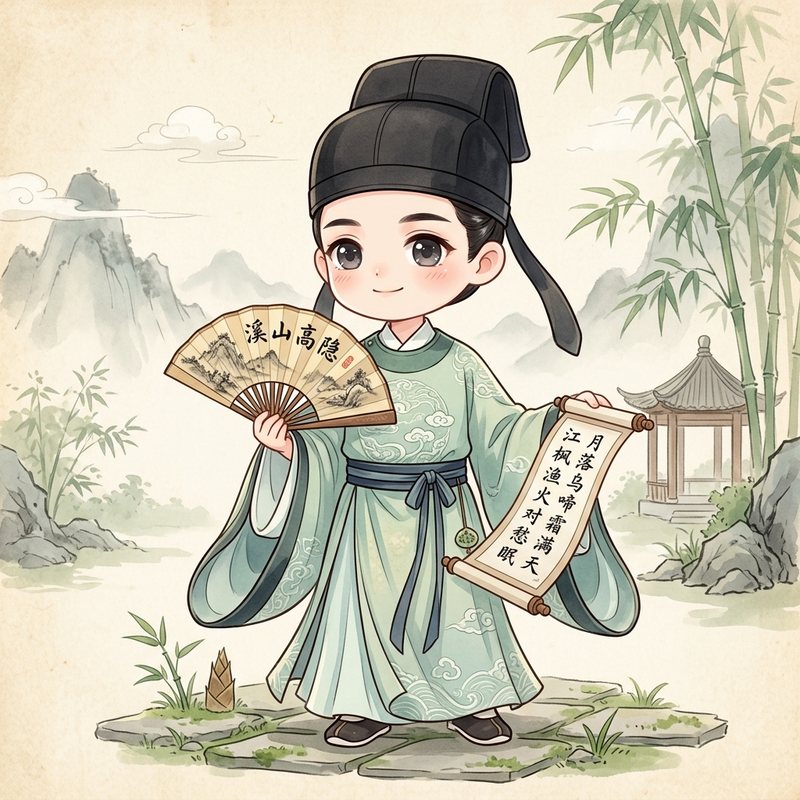
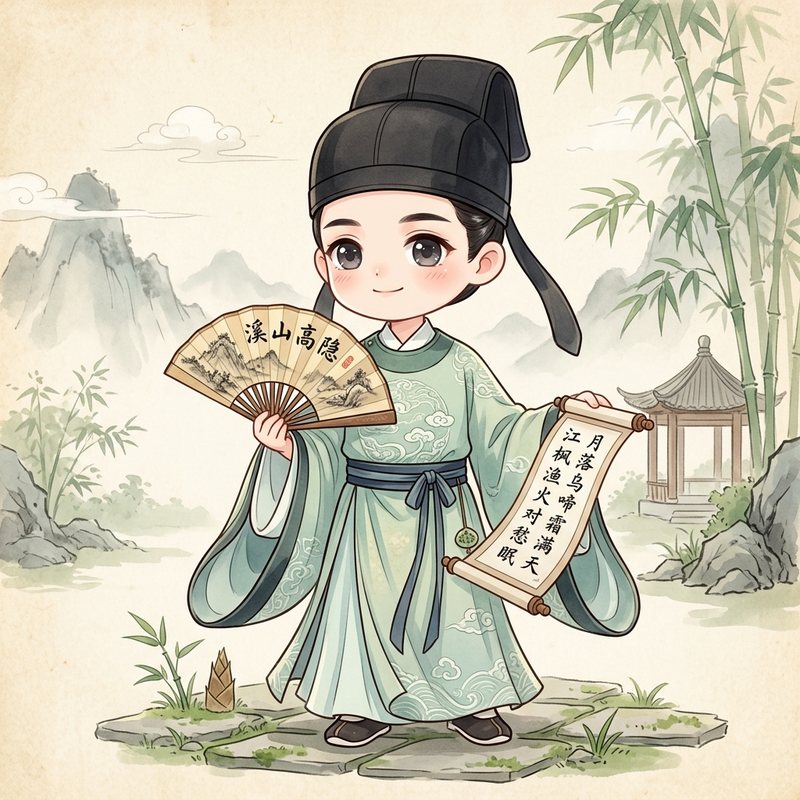
Master of Song Poetry and Wild Cursive CalligraphySong Dynasty(1045—1105)字鲁直 · 号山谷道人/涪翁Audio Journey · 9 Stops
Founder of the Jiangxi Poetry School, chief of the Four Scholars of the Su Gate, and titan of Song wild cursive calligraphy.
Founder of the Jiangxi Poetry School· John Donne & T.S. EliotTitan of Song Calligraphy· Franz KlineTwenty-Four Filial Exemplars· A model of selfless filial devotion
Unfolding the Historical Landscape…
印
Daily Wisdom & Resilience Oracle
The Resilient Optimist
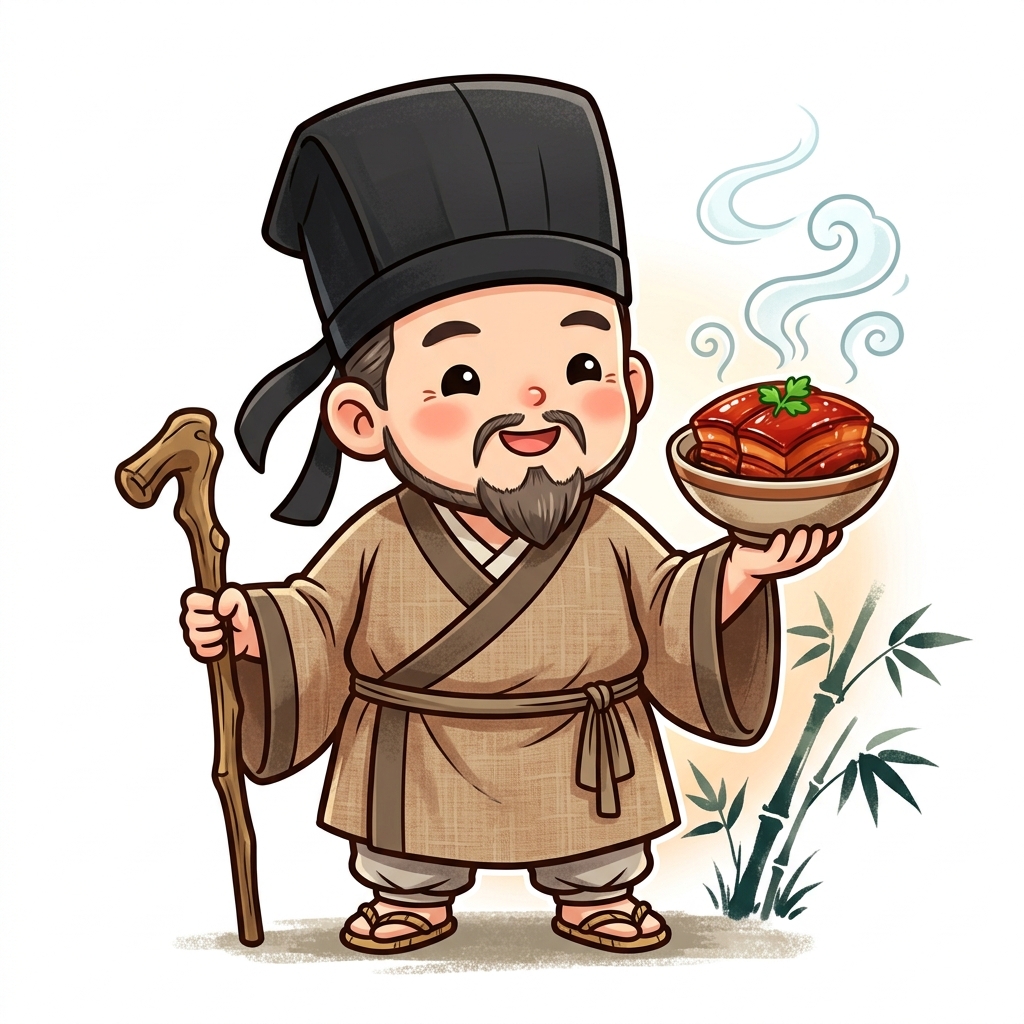
“竹杖芒鞋轻胜马,谁怕?一蓑烟雨任平生。”
Holding a bamboo cane and wearing straw sandals, I stride faster than a horse. Who is afraid? A straw cloak in the mist and rain — I live my life with equanimity.
💡 In the 3rd year of exile in Huangzhou, caught in a sudden downpour, Su Shi embraced the storm with supreme resilience.
— Su Shi (Dongpo)(The Renaissance Foodie & Optimist)
Historical Footprints & Narration Archive
9 Stations
1
Fenning, Hongzhou
1045 CE · Age 0
Cradle of the Huang clan and green tea highlands of Jiangxi, modern Xiushui
In 1045 CE, Huang Tingjian was born into an illustrious clan in Jiangxi, blessed with photographic memory and deep classical learning.
“幼承庭训,天资卓绝。”
Yòu chéng tíng xùn, tiān zī zhuó jué.
Born to an illustrious scholarly family, young Tingjian absorbed Confucian virtue and demonstrated astounding literary genius from early childhood.
Station Narration Script
In 1045 CE, Huang Tingjian was born into a distinguished scholarly clan in Shuangjing Village, Fenning, Jiangxi. Gifted with a photographic memory, he memorized the Confucian classics by age five and was admired throughout the region for his filial piety. The serene mountains and tea hills of Jiangxi endowed him with pure poetic sensibility and unyielding integrity, opening the first chapter of his legendary life.
Departure Transition Script
Following his father's early death, young Huang Tingjian accompanied his maternal uncle Li Chang to study across the empire.
2
Yexian, Ruzhou
1063 CE · Age 18
Ancient Central Plains scholarly retreat on the Ying River basin, modern Pingdingshan
In his uncle's private library of ten thousand scrolls at Yexian, Huang immersed himself in deep philological and poetic studies.
“博学审问,慎思明辨。”
Bó xué shěn wèn, shèn sī míng biàn.
Study extensively, inquire prudently, think carefully, and judge clearly.
Station Narration Script
During his years in Yexian, young Huang Tingjian devoted himself to scholarship under his uncle Li Chang. Surrounded by thousands of rare volumes, Tingjian analyzed Tang poetic forms, focusing particularly on Du Fu's syntactic architecture. By lamplight, he cultivated the scholarly depth and poetic rigor that would distinguish his mature literary voice.
Departure Transition Script
In 1067 CE, twenty-two-year-old Huang Tingjian traveled to the Song imperial capital of Kaifeng to sit for the Jinshi examinations.
3
Kaifeng, Henan
1067 CE · Age 22
Northern Song imperial metropolis and imperial examination center, modern Kaifeng
In 1067 CE, twenty-two-year-old Huang Tingjian triumphed in the imperial examinations at Kaifeng, earning the Jinshi degree.
“春风得意马蹄疾,金榜题名步青云。”
Chūn fēng dé yì mǎ tí jí, jīn bǎng tí míng bù qīng yún.
The spring breeze carries joyous hooves as his name is inscribed on the golden imperial register, stepping into civil prominence.
Station Narration Script
At the imperial banquet in Kaifeng, twenty-two-year-old Huang Tingjian celebrated his examination success, his name echoing across the capital. Unmoved by metropolitan luxury, he upheld his Confucian calling of public service. Appointed as a provincial sheriff, he defended local peasants with integrity while dutifully caring for his mother, marking a noble entry into imperial life.
Departure Transition Script
In 1072 CE, Huang Tingjian was appointed professor at the Northern Capital Academy, traveling north to Daming Prefecture.
4
Daming Prefecture
1072 CE · Age 27
Northern secondary capital of Song Empire, modern Handan, Hebei
Teaching at Daming's imperial academy for seven years, Huang established a lifelong alliance with Su Shi, who championed his genius.
Vast, serene, and resonant with profound undertones, his prose echoes with timeless nobility.
Station Narration Script
At the imperial academy in Daming, Huang Tingjian taught for seven years, where the rugged frontier plains expanded his artistic vision. During this pivotal era, his correspondence with Su Shi blossomed into deep intellectual kinship. Su's glowing public praise catapulted Huang into the front rank of Song poets, preparing him for the poetic revolution to come.
Departure Transition Script
In 1080 CE, Huang Tingjian was appointed magistrate of Taihe County in Jizhou, returning south to govern a regional magistracy.
5
Taihe, Jizhou
1080 CE · Age 35
Scenic riverside county along the Gan River and site of Kuaige Pavilion, modern Ji'an
Governing Taihe with compassionate wisdom, Magistrate Huang climbed Kuaige Pavilion to compose the immortal poem 'Ascending Kuaige Pavilion'.
Across a thousand hills stripped leaves leave the heavens vast and high; along a clear singular river the moon shines crisp and bright.
Station Narration Script
During his three years as magistrate of Taihe, Huang Tingjian governed with benevolence and integrity. After arduous days of administrative duties, he would climb Kuaige Pavilion above the Gan River. The autumn winds through stripped mountains and the moonlit river washed away all bureaucratic exhaustion, blending civic devotion with transcendental detachment in immortal verse.
Departure Transition Script
In 1084 CE, Huang Tingjian completed his term in Taihe and traveled north to oversee the tax post at Deping Town in Shandong.
6
Deping, Dezhou
1084 CE · Age 39
Quiet northern canal town and imperial wine taxation station, modern Dezhou
Serving in a modest tax post at Deping, Huang composed 'To Huang Jifu', inventing the dense intellectual style of Song poetics.
A cup of wine amid peach and plum blossoms in the spring breeze; ten years of night rain by lonely lamps adrift on lakes and rivers.
Station Narration Script
In his spartan quarters at Deping, Huang Tingjian embraced austere solitude. Listening to evening rain lashing the window, he recalled joyful youth drinking spring wine with Huang Jifu, set against a decade of wandering alone by distant lamps. Combining startling images without connective filler, the couplet created an enduring monument of deep emotion and intellectual elegance.
Departure Transition Script
In 1086 CE, Emperor Zhezong ascended the throne, and Huang Tingjian was summoned back to Kaifeng to serve in the imperial library.
7
Kaifeng, Henan
1086 CE · Age 41
Northern Song court library and imperial historiography center, modern Kaifeng
Summoned to Kaifeng in the Yuanyou era, Huang compiled imperial annals, led the Four Scholars of the Su Gate, and became a master calligrapher.
“花气熏人欲破禅,心情其实过中年。”
Huā qì xūn rén yù pò chán, xīn qíng qí shí guò zhōng nián.
The rich scent of flowers threatens to break my Zen meditation; in truth my spirit has already crossed past middle age.
Station Narration Script
During the Yuanyou era, Kaifeng experienced the golden age of Northern Song culture. In the palace archives, Huang compiled the 'Veritable Records of Emperor Shenzong' with fearless historical accuracy. Away from court, he joined Su Shi to discuss poetry, philosophy, and calligraphy. His sweeping cursive strokes revolutionized Chinese calligraphy, maintaining zen mindfulness amidst metropolitan splendor.
Departure Transition Script
In 1094 CE, factional purges resumed, and Huang was demoted over imperial records, exiled southwest to remote Qianzhou.
8
Qianzhou
1094 CE · Age 49
Misty mountain river outpost of southwestern Sichuan basin, modern Chongqing
Exiled to the rugged southwest, Huang adopted the name Mountain Valley Daoist, transmuting hardship into cursive calligraphy masterpieces.
Do not mock the proud bearing of this old man; look yourself—how many wear yellow chrysanthemums upon their white crowns?
Station Narration Script
In the deep gorges of Qianzhou, perpetual mists and tropical diseases haunted daily life. Plunged from high office into frontier banishment, Huang harbored no bitterness. Living beside the roaring river, he dipped his brush in ink, pouring life's injustices onto paper. Watching boatmen navigate raging rapids, he unlocked the kinetic rhythm of wild cursive, completing an astonishing spiritual and artistic breakthrough.
Departure Transition Script
Briefly pardoned in 1100 CE, Huang was soon targeted by the Yuanyou Partisans Stele purge, banished to southernmost Yizhou.
9
Yizhou
1104 CE · Age 59
Subtropical southern karst frontier along the Long River, modern Hechi, Guangxi
Lodged atop a drafty gatehouse in southernmost Yizhou, Huang embraced mortal limits with sublime equanimity and serene poetic grace.
All my life my wish was for deep brimmed wine; ten years cast out from the court have aged away all youthful ambition.
Station Narration Script
Aloft the southern city gate in Yizhou, drafts blew constantly through Huang's spartan quarters. Though sixty years old and ailing, his mind remained as calm as still water. Composing his lyric to winter plum blossoms, he acknowledged a decade of exile without a trace of anger. On stormy nights, he amused himself by washing his feet in rainwater streaming from the eaves. Serene and untamed, the master closed his eyes into eternity, leaving an everlasting spiritual beacon.
Departure Transition Script
On November 8, 1105 CE, Huang Tingjian passed away peacefully in Yizhou, mourned by students who returned his casket to Jiangxi.
Key Historical Inquiries & Context
· 核心史实公案与速览
Huang Tingjian (1045–1105), styled Luzhi and known as Shangu Daoren and Fu Weng, was an eminent Northern Song Dynasty poet, scholar, and calligrapher from Fenning, Jiangxi. Passing the Jinshi examinations at twenty-two, he served in academic and municipal posts before compiling the 'Veritable Records of Emperor Shenzong' during the Yuanyou era. He stood at the center of the empire's literary apex as leader of the Four Scholars of the Su Gate and one of the Four Masters of Song Calligraphy. Repeatedly purged during factional upheavals, he was banished to Qianzhou and Yizhou. Huang pioneered the Jiangxi Poetry School by formulating 'turning iron into gold' and transformative syntactic methods, while elevating wild cursive calligraphy into dynamic abstract art. Serene through adversity and honored among the Twenty-Four Filial Exemplars, his legacy endures as a pinnacle of Chinese civilization.
Huang Tingjian (1045–1105), styled Luzhi and known as Shangu Daoren and Fu Weng, was an eminent Northern Song Dynasty poet, scholar, and calligrapher from Fenning, Jiangxi. Passing the Jinshi examinations at twenty-two, he served in academic and municipal posts before compiling the 'Veritable Records of Emperor Shenzong' during the Yuanyou era. He stood at the center of the empire's literary apex as leader of the Four Scholars of the Su Gate and one of the Four Masters of Song Calligraphy. Repeatedly purged during factional upheavals, he was banished to Qianzhou and Yizhou. Huang pioneered the Jiangxi Poetry School by formulating 'turning iron into gold' and transformative syntactic methods, while elevating wild cursive calligraphy into dynamic abstract art. Serene through adversity and honored among the Twenty-Four Filial Exemplars, his legacy endures as a pinnacle of Chinese civilization.
QWhat was Huang Tingjian's primary cultural and historical legacy?
Huang Tingjian is celebrated across world history as a pioneer of Founder of the Jiangxi Poetry School, Titan of Song Calligraphy, Twenty-Four Filial Exemplars, leaving enduring philosophical insights, literature, and art.
QWhere does Huang Tingjian's historical life journey map lead?
This interactive GIS map retraces 9 chronological stops across Song Dynasty China, originating from Fenning, Hongzhou and spanning through Yizhou.
The Complete Life Journey & Biography of Huang Tingjian (Song Poet) (黄庭坚)
Chronological travel & exile routes mapped to modern Chinese cities across Song Dynasty China — featuring bilingual scholar audio, classical poetry recitations, and historical cross-paths.
Fenning, Hongzhou (洪州分宁)
Age 0
Modern-day analog: Cradle of the Huang clan and green tea highlands of Jiangxi, modern Xiushui
In 1045 CE, Huang Tingjian was born into an illustrious clan in Jiangxi, blessed with photographic memory and deep classical learning.
In 1045 CE, Huang Tingjian was born into a distinguished scholarly clan in Shuangjing Village, Fenning, Jiangxi. Gifted with a photographic memory, he memorized the Confucian classics by age five and was admired throughout the region for his filial piety. The serene mountains and tea hills of Jiangxi endowed him with pure poetic sensibility and unyielding integrity, opening the first chapter of his legendary life.
Following his father's early death, young Huang Tingjian accompanied his maternal uncle Li Chang to study across the empire.
“Born to an illustrious scholarly family, young Tingjian absorbed Confucian virtue and demonstrated astounding literary genius from early childhood.”
Modern-day analog: Ancient Central Plains scholarly retreat on the Ying River basin, modern Pingdingshan
In his uncle's private library of ten thousand scrolls at Yexian, Huang immersed himself in deep philological and poetic studies.
During his years in Yexian, young Huang Tingjian devoted himself to scholarship under his uncle Li Chang. Surrounded by thousands of rare volumes, Tingjian analyzed Tang poetic forms, focusing particularly on Du Fu's syntactic architecture. By lamplight, he cultivated the scholarly depth and poetic rigor that would distinguish his mature literary voice.
In 1067 CE, twenty-two-year-old Huang Tingjian traveled to the Song imperial capital of Kaifeng to sit for the Jinshi examinations.
“Study extensively, inquire prudently, think carefully, and judge clearly.”
博学审问,慎思明辨。 (Bó xué shěn wèn, shèn sī míng biàn.)
Kaifeng, Henan (河南开封)
Age 22
Modern-day analog: Northern Song imperial metropolis and imperial examination center, modern Kaifeng
In 1067 CE, twenty-two-year-old Huang Tingjian triumphed in the imperial examinations at Kaifeng, earning the Jinshi degree.
At the imperial banquet in Kaifeng, twenty-two-year-old Huang Tingjian celebrated his examination success, his name echoing across the capital. Unmoved by metropolitan luxury, he upheld his Confucian calling of public service. Appointed as a provincial sheriff, he defended local peasants with integrity while dutifully caring for his mother, marking a noble entry into imperial life.
In 1072 CE, Huang Tingjian was appointed professor at the Northern Capital Academy, traveling north to Daming Prefecture.
“The spring breeze carries joyous hooves as his name is inscribed on the golden imperial register, stepping into civil prominence.”
春风得意马蹄疾,金榜题名步青云。 (Chūn fēng dé yì mǎ tí jí, jīn bǎng tí míng bù qīng yún.)
Daming Prefecture (大名府)
Age 27
Modern-day analog: Northern secondary capital of Song Empire, modern Handan, Hebei
Teaching at Daming's imperial academy for seven years, Huang established a lifelong alliance with Su Shi, who championed his genius.
At the imperial academy in Daming, Huang Tingjian taught for seven years, where the rugged frontier plains expanded his artistic vision. During this pivotal era, his correspondence with Su Shi blossomed into deep intellectual kinship. Su's glowing public praise catapulted Huang into the front rank of Song poets, preparing him for the poetic revolution to come.
In 1080 CE, Huang Tingjian was appointed magistrate of Taihe County in Jizhou, returning south to govern a regional magistracy.
“Vast, serene, and resonant with profound undertones, his prose echoes with timeless nobility.”
Modern-day analog: Scenic riverside county along the Gan River and site of Kuaige Pavilion, modern Ji'an
Governing Taihe with compassionate wisdom, Magistrate Huang climbed Kuaige Pavilion to compose the immortal poem 'Ascending Kuaige Pavilion'.
During his three years as magistrate of Taihe, Huang Tingjian governed with benevolence and integrity. After arduous days of administrative duties, he would climb Kuaige Pavilion above the Gan River. The autumn winds through stripped mountains and the moonlit river washed away all bureaucratic exhaustion, blending civic devotion with transcendental detachment in immortal verse.
In 1084 CE, Huang Tingjian completed his term in Taihe and traveled north to oversee the tax post at Deping Town in Shandong.
“Across a thousand hills stripped leaves leave the heavens vast and high; along a clear singular river the moon shines crisp and bright.”
Modern-day analog: Quiet northern canal town and imperial wine taxation station, modern Dezhou
Serving in a modest tax post at Deping, Huang composed 'To Huang Jifu', inventing the dense intellectual style of Song poetics.
In his spartan quarters at Deping, Huang Tingjian embraced austere solitude. Listening to evening rain lashing the window, he recalled joyful youth drinking spring wine with Huang Jifu, set against a decade of wandering alone by distant lamps. Combining startling images without connective filler, the couplet created an enduring monument of deep emotion and intellectual elegance.
In 1086 CE, Emperor Zhezong ascended the throne, and Huang Tingjian was summoned back to Kaifeng to serve in the imperial library.
“A cup of wine amid peach and plum blossoms in the spring breeze; ten years of night rain by lonely lamps adrift on lakes and rivers.”
Modern-day analog: Northern Song court library and imperial historiography center, modern Kaifeng
Summoned to Kaifeng in the Yuanyou era, Huang compiled imperial annals, led the Four Scholars of the Su Gate, and became a master calligrapher.
During the Yuanyou era, Kaifeng experienced the golden age of Northern Song culture. In the palace archives, Huang compiled the 'Veritable Records of Emperor Shenzong' with fearless historical accuracy. Away from court, he joined Su Shi to discuss poetry, philosophy, and calligraphy. His sweeping cursive strokes revolutionized Chinese calligraphy, maintaining zen mindfulness amidst metropolitan splendor.
In 1094 CE, factional purges resumed, and Huang was demoted over imperial records, exiled southwest to remote Qianzhou.
“The rich scent of flowers threatens to break my Zen meditation; in truth my spirit has already crossed past middle age.”
花气熏人欲破禅,心情其实过中年。 (Huā qì xūn rén yù pò chán, xīn qíng qí shí guò zhōng nián.)
Qianzhou (黔州)
Age 49
Modern-day analog: Misty mountain river outpost of southwestern Sichuan basin, modern Chongqing
Exiled to the rugged southwest, Huang adopted the name Mountain Valley Daoist, transmuting hardship into cursive calligraphy masterpieces.
In the deep gorges of Qianzhou, perpetual mists and tropical diseases haunted daily life. Plunged from high office into frontier banishment, Huang harbored no bitterness. Living beside the roaring river, he dipped his brush in ink, pouring life's injustices onto paper. Watching boatmen navigate raging rapids, he unlocked the kinetic rhythm of wild cursive, completing an astonishing spiritual and artistic breakthrough.
Briefly pardoned in 1100 CE, Huang was soon targeted by the Yuanyou Partisans Stele purge, banished to southernmost Yizhou.
“Do not mock the proud bearing of this old man; look yourself—how many wear yellow chrysanthemums upon their white crowns?”
Modern-day analog: Subtropical southern karst frontier along the Long River, modern Hechi, Guangxi
Lodged atop a drafty gatehouse in southernmost Yizhou, Huang embraced mortal limits with sublime equanimity and serene poetic grace.
Aloft the southern city gate in Yizhou, drafts blew constantly through Huang's spartan quarters. Though sixty years old and ailing, his mind remained as calm as still water. Composing his lyric to winter plum blossoms, he acknowledged a decade of exile without a trace of anger. On stormy nights, he amused himself by washing his feet in rainwater streaming from the eaves. Serene and untamed, the master closed his eyes into eternity, leaving an everlasting spiritual beacon.
On November 8, 1105 CE, Huang Tingjian passed away peacefully in Yizhou, mourned by students who returned his casket to Jiangxi.
“All my life my wish was for deep brimmed wine; ten years cast out from the court have aged away all youthful ambition.”