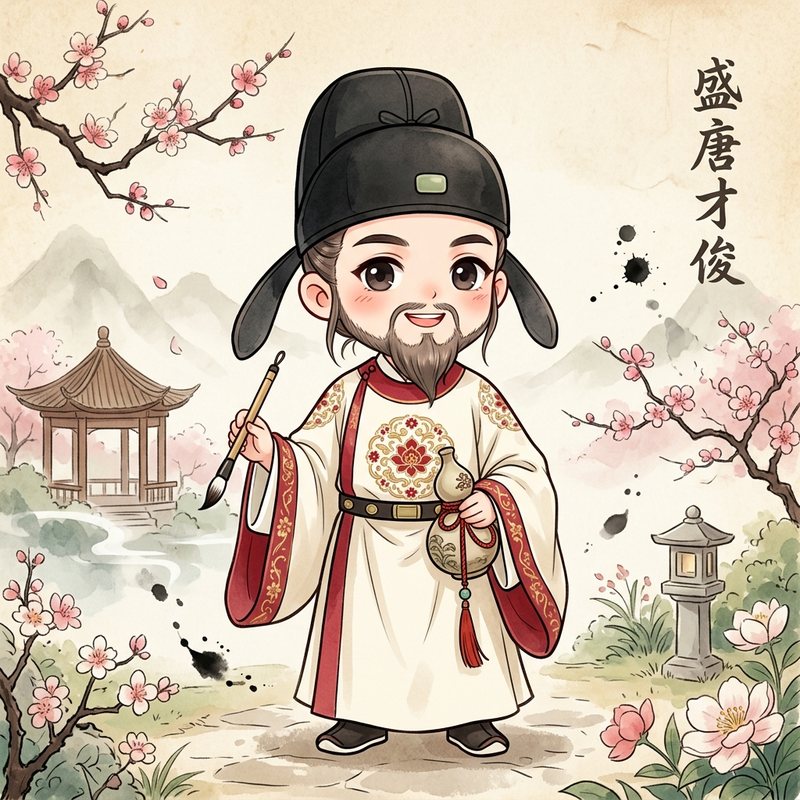
The Romantic Soul of Late TangTang Dynasty(812—858)字义山 · 号玉谿生/樊南生Audio Journey · 10 Stops
The Romantic Soul of Late Tang: master of untitled poetry who wove mystery, longing, and sublime elegance into timeless verses.
The Keats of Late Tang· John KeatsMaster of the Untitled Riddle· Stéphane MallarméThe Tragic Wanderer of Factional Strife· Dante Alighieri
Unfolding the Historical Landscape…
印
Daily Wisdom & Resilience Oracle
The Resilient Optimist
“竹杖芒鞋轻胜马,谁怕?一蓑烟雨任平生。”
Holding a bamboo cane and wearing straw sandals, I stride faster than a horse. Who is afraid? A straw cloak in the mist and rain — I live my life with equanimity.
💡 In the 3rd year of exile in Huangzhou, caught in a sudden downpour, Su Shi embraced the storm with supreme resilience.
— Su Shi (Dongpo)(The Renaissance Foodie & Optimist)
Historical Footprints & Narration Archive
10 Stations
1
Henei Birthplace
812 CE · Age 0
Ancestral cradle in modern Qinyang, Henan
Born into a faded clan and orphaned at ten, he supported his family by copying books, forging immense talent in adversity.
“生归苏武义,死赠李陵诗。”
Shēng guī Sū Wǔ yì, sǐ zèng Lǐ Líng shī.
In life, returning with Su Wu's unbroken integrity; in death, parting with Li Ling's immortal verse.
Station Narration Script
In 812 CE, Li Shangyin was born in Henei. Though descended from the imperial house, his family had long fallen into poverty. When his father died prematurely, ten-year-old Li Shangyin shouldered the burden as eldest son, copying manuscripts for meager grain to sustain his widowed mother and siblings. Hardship did not break him; by lamplight he cultivated an acute sensibility that sowed the seeds for his future poetic brilliance.
Departure Transition Script
In early Dahe reign, youthful Li Shangyin left his hometown for the eastern capital of Luoyang to seek masters and acclaim.
2
Luoyang Mentorship
829 CE · Age 17
Eastern capital and literary gathering grounds, modern Luoyang, Henan
Mentored by Prime Minister Linghu Chu in parallel prose, winning fame across Luoyang and earning high praise from Bai Juyi.
“恩重青云外,身轻沧海边。”
Ēn zhòng qīng yún wài, shēn qīng cāng hǎi biān.
Your immense benevolence reaches far beyond the azure clouds; my humble self stands unburdened beside the boundless sea.
Station Narration Script
In the blooming eastern capital of Luoyang, Li Shangyin met Linghu Chu, the mentor who transformed his life. Treating him like a son, Linghu Chu instructed him in exquisite parallel prose and funded his imperial examinations. Renowned literati praised the young scholar, and the elder giant Bai Juyi was thoroughly captivated. Amid Luoyang's blossoms and music, Li enjoyed the most radiant days of his youth.
Departure Transition Script
In 837 CE, fully prepared, Li Shangyin journeyed to Chang'an to sit for the imperial Jinshi examinations.
3
Chang'an Examination Triumph
837 CE · Age 25
Imperial capital examinations hall, modern Xi'an, Shaanxi
Passing the Jinshi examination at twenty-five, but losing his beloved mentor Linghu Chu in the same tragic winter.
“十年磨一剑,从此踏青云。”
Shí nián mó yī jiàn, cóng cǐ tà qīng yún.
A decade spent grinding a single blade, now at last stepping forth into the azure clouds.
Station Narration Script
Chang'an's imperial pavilions and Qujiang blossoms witnessed Li Shangyin's triumph at twenty-five, passing the Jinshi examination. Years of hard study had yielded sweet fruit. Yet fate delivered a cruel blow: that very winter, his mentor Linghu Chu died. Without hesitation, the young graduate rode thousands of miles to mourn at the bier. The collision of triumph and sorrow set the tone for his tumultuous life.
Departure Transition Script
The following spring, seeking livelihood, Li Shangyin accepted an invitation to the northwestern frontier from Wang Maoyuan.
4
Jingzhou Marriage & Factional Rift
838 CE · Age 26
Frontier garrison on Silk Road trail, modern Jingchuan, Gansu
Marrying his devoted wife on the frontier, yet unwittingly caught in the vicious crossfire of late Tang factional warfare.
Last night's stars, last night's gentle wind, west of the painted pavilion, east of the cassia hall. Although my body lacks colorful phoenix wings to fly to you, our hearts are joined like the single spiritual streak within the sacred horn.
Station Narration Script
Amid frontier watchtowers in Jingzhou, Li Shangyin found the true love of his life. His father-in-law admired his scholarship, and his wife Wang Yanling was gentle and cultivated. Yet this union sparked personal tragedy. In the late Tang court, the Niu and Li factions were locked in mortal combat. The innocent poet did not realize that by marrying Wang's daughter, he became branded as a traitor, caught between colliding waves.
Departure Transition Script
At the end of Kaicheng reign, Li Shangyin returned to Chang'an, passing the civil selection to take up a judicial post.
5
Chang'an Palace Library & Hongnong
842 CE · Age 30
Imperial secretariat archives in modern Xi'an, Shaanxi
Defying superiors to protect innocent prisoners in Hongnong, and penning the biting political satire 'Jia Sheng' in Chang'an.
In the Xuan Chamber seeking talent, the emperor consulted the banished exile; scholar Jia's genius was beyond compare. Pity that at midnight the emperor leaned forward in vain, asking not about the suffering people, but about ghosts and spirits.
Station Narration Script
Serving as Lieutenant of Hongnong, the gentle poet displayed an unbending backbone. When senior officials forced false confessions on innocent peasants, he slammed his desk and resigned rather than sign death warrants. Relegated to dusty library archives in Chang'an, he observed imperial infatuation with Daoist sorcery and penned 'Jia Sheng': 'Pity that at midnight the emperor leaned forward in vain, asking not about the people, but about ghosts and spirits!'
Departure Transition Script
In 847 CE, another court purge took place, and Li Shangyin followed Zheng Ya south to remote Guizhou.
6
Guizhou Karst Sojourn
847 CE · Age 35
Karst limestone mountains along Li River, modern Guilin, Guangxi
Traveling thousands of miles south to serve as secretary in Guilin, distilling delicate poetic longing amid karst river valleys.
Dwelling over misty waters day and night, overcast clouds and dawn glows gather and disperse. Clouds wrap round ancient river stones, while gentle breezes flutter strands of floating green algae.
Station Narration Script
Under political turmoil, Li Shangyin bid farewell to his wife and children to journey south to Guilin. The sheer karst peaks and emerald waters of the Li River consoled the exiled poet's lonely spirit. As secretary, he performed his duties diligently; in spare hours, he drifted upon clear waters watching mist shift across jagged crags. Southern breezes washed away heavy ambitions, turning adversity into translucent lyrical beauty.
Departure Transition Script
Following the dissolution of the Guizhou staff, Li Shangyin returned north to take a post in Xuzhou.
7
Xuzhou Headquarters & Bereavement
850 CE · Age 38
Northern martial fortress along Grand Canal, modern Xuzhou, Jiangsu
Learning in Xuzhou of his beloved wife's sudden death in Chang'an, pouring inconsolable grief into immortal elegies.
The spring silkworm spins silk until it dies; the candle turns to ash before its tears dry.
Station Narration Script
In the military camp of Xuzhou, Li Shangyin was drafting documents when a letter from Chang'an arrived like a thunderclap: his wife Wang Yanling had passed away. Hundreds of miles separated them; he could not hold her cold hand or hear her final words. She was the one soul who understood his purity and sorrow, now gone forever. Resigning immediately, he hurried back to Chang'an, weeping over her belongings. In raw grief, his love was forged into eternal verse.
Departure Transition Script
To provide for his young motherless children, Li Shangyin crossed the rugged sword-gate pass into Sichuan.
8
Zizhou Sanctuary & Poetic Summit
851 CE · Age 39
Misty river valleys of Ba-Shu mountain redoubt, modern Santai, Sichuan
Finding refuge under Liu Zhongying in Sichuan, composing 'Night Rain' and 'The Inlaid Zither' amid mountain downpours.
You ask the date of my return, but no date is set; night rain on Mount Ba swells the autumn pools. When shall we trim the candle by the west window together, and talk once more of the night rain on Mount Ba?
Station Narration Script
Surrounded by Sichuan's misty mountains in Zizhou, Li Shangyin finally found a sanctuary for his soul. Military Commissioner Liu Zhongying treated him as a cherished confidant, granting him retreat in mountain monasteries to read Buddhist scriptures. Outside, relentless autumn rain filled the pools; inside, oil lamps illuminated a fifty-stringed zither. Here he united a lifetime of displacement, memory, and existential meditation into 'The Inlaid Zither'. All suffering was transfigured into immortal beauty.
Departure Transition Script
In 855 CE, Liu Zhongying was recalled to Chang'an as Minister of Justice, and Li Shangyin returned with him.
9
Chang'an Leyou Plain Sunset
855 CE · Age 43
Leyou Plateau scenic heights, modern Xi'an, Shaanxi
Returning as Salt and Iron Judicatus, ascending Leyou Plain at dusk to utter the immortal lament on the fading Tang empire.
Towards evening, feeling unsettled in spirit, I drove my carriage up to the ancient plateau. The setting sun glows with boundless beauty, only it is so close to twilight.
Station Narration Script
After decades of wandering, Li Shangyin returned to Chang'an. But the capital was no longer the vibrant metropolis of his youth. At dusk in the chill autumn wind, he climbed Leyou Plain alone in his carriage. As far as the eye could see, the setting sun bathed the majestic ancient city in tragic golden red. He sensed the irreversible sunset of the Tang civilization: 'The setting sun glows with boundless beauty, only it is so close to twilight.' It was the final elegy of a golden age.
Departure Transition Script
In 856 CE, Liu Zhongying was transferred, and Li Shangyin resigned due to failing health, retiring to his ancestral home.
10
Zhengzhou Resting Place
858 CE · Age 46
Ancestral farmsteads of the Central Plains, modern Zhengzhou, Henan
Retiring in ill health to his ancestral home in Zhengzhou, passing away quietly while his manuscripts became immortal classics.
Could this feeling have waited to become a cherished memory? Even then, in the very moment, all was bewilderment and wonder.
Station Narration Script
In his ancestral home south of the Yellow River in Zhengzhou, Li Shangyin spent his final peaceful days. Across forty-six tumultuous years, he had struggled in factional strife, grieved the loss of his wife, and attained enlightenment amid mountain rains. On his sickbed, with serene calm, he laid down his brush. Earthly slander and neglect faded with the wind; but his verse, infused with tears and genius, ascended as luminous constellations in the night sky of civilization.
Departure Transition Script
Li Shangyin lived his life turning profound emotion into verse. His romantic and symbolic vision stands forever in the highest pantheon of Tang poetry.
Key Historical Inquiries & Context
· 核心史实公案与速览
Li Shangyin (c. 813–858 CE) was one of the most brilliant and enigmatic poets of the late Tang Dynasty, renowned for his sensual, imagistic, and deliberately ambiguous "Untitled" (无题) poems.
Li Shangyin (c. 813–858 CE) was a major late Tang Dynasty poet known alongside Du Mu as "Little Li and Du". His poetry is famous for intricate symbolism, emotional depth, and allusive romantic melancholy.
QWhy are Li Shangyin's poems called "Untitled"?
Many of Li Shangyin's most famous romantic and political poems are titled "Untitled" (无题, Wuti) because they convey guarded secrets, forbidden court romances, or dangerous political allegories in an era of deadly factional strife.
The Complete Life Journey & Biography of Li Shangyin (Late Tang Poet) (李商隐)
Chronological travel & exile routes mapped to modern Chinese cities across Tang Dynasty China — featuring bilingual scholar audio, classical poetry recitations, and historical cross-paths.
Henei Birthplace (怀州河内)
Age 0
Modern-day analog: Ancestral cradle in modern Qinyang, Henan
Born into a faded clan and orphaned at ten, he supported his family by copying books, forging immense talent in adversity.
In 812 CE, Li Shangyin was born in Henei. Though descended from the imperial house, his family had long fallen into poverty. When his father died prematurely, ten-year-old Li Shangyin shouldered the burden as eldest son, copying manuscripts for meager grain to sustain his widowed mother and siblings. Hardship did not break him; by lamplight he cultivated an acute sensibility that sowed the seeds for his future poetic brilliance.
In early Dahe reign, youthful Li Shangyin left his hometown for the eastern capital of Luoyang to seek masters and acclaim.
“In life, returning with Su Wu's unbroken integrity; in death, parting with Li Ling's immortal verse.”
Modern-day analog: Eastern capital and literary gathering grounds, modern Luoyang, Henan
Mentored by Prime Minister Linghu Chu in parallel prose, winning fame across Luoyang and earning high praise from Bai Juyi.
In the blooming eastern capital of Luoyang, Li Shangyin met Linghu Chu, the mentor who transformed his life. Treating him like a son, Linghu Chu instructed him in exquisite parallel prose and funded his imperial examinations. Renowned literati praised the young scholar, and the elder giant Bai Juyi was thoroughly captivated. Amid Luoyang's blossoms and music, Li enjoyed the most radiant days of his youth.
In 837 CE, fully prepared, Li Shangyin journeyed to Chang'an to sit for the imperial Jinshi examinations.
“Your immense benevolence reaches far beyond the azure clouds; my humble self stands unburdened beside the boundless sea.”
Modern-day analog: Imperial capital examinations hall, modern Xi'an, Shaanxi
Passing the Jinshi examination at twenty-five, but losing his beloved mentor Linghu Chu in the same tragic winter.
Chang'an's imperial pavilions and Qujiang blossoms witnessed Li Shangyin's triumph at twenty-five, passing the Jinshi examination. Years of hard study had yielded sweet fruit. Yet fate delivered a cruel blow: that very winter, his mentor Linghu Chu died. Without hesitation, the young graduate rode thousands of miles to mourn at the bier. The collision of triumph and sorrow set the tone for his tumultuous life.
The following spring, seeking livelihood, Li Shangyin accepted an invitation to the northwestern frontier from Wang Maoyuan.
“A decade spent grinding a single blade, now at last stepping forth into the azure clouds.”
Modern-day analog: Frontier garrison on Silk Road trail, modern Jingchuan, Gansu
Marrying his devoted wife on the frontier, yet unwittingly caught in the vicious crossfire of late Tang factional warfare.
Amid frontier watchtowers in Jingzhou, Li Shangyin found the true love of his life. His father-in-law admired his scholarship, and his wife Wang Yanling was gentle and cultivated. Yet this union sparked personal tragedy. In the late Tang court, the Niu and Li factions were locked in mortal combat. The innocent poet did not realize that by marrying Wang's daughter, he became branded as a traitor, caught between colliding waves.
At the end of Kaicheng reign, Li Shangyin returned to Chang'an, passing the civil selection to take up a judicial post.
“Last night's stars, last night's gentle wind, west of the painted pavilion, east of the cassia hall. Although my body lacks colorful phoenix wings to fly to you, our hearts are joined like the single spiritual streak within the sacred horn.”
Modern-day analog: Imperial secretariat archives in modern Xi'an, Shaanxi
Defying superiors to protect innocent prisoners in Hongnong, and penning the biting political satire 'Jia Sheng' in Chang'an.
Serving as Lieutenant of Hongnong, the gentle poet displayed an unbending backbone. When senior officials forced false confessions on innocent peasants, he slammed his desk and resigned rather than sign death warrants. Relegated to dusty library archives in Chang'an, he observed imperial infatuation with Daoist sorcery and penned 'Jia Sheng': 'Pity that at midnight the emperor leaned forward in vain, asking not about the people, but about ghosts and spirits!'
In 847 CE, another court purge took place, and Li Shangyin followed Zheng Ya south to remote Guizhou.
“In the Xuan Chamber seeking talent, the emperor consulted the banished exile; scholar Jia's genius was beyond compare. Pity that at midnight the emperor leaned forward in vain, asking not about the suffering people, but about ghosts and spirits.”
Modern-day analog: Karst limestone mountains along Li River, modern Guilin, Guangxi
Traveling thousands of miles south to serve as secretary in Guilin, distilling delicate poetic longing amid karst river valleys.
Under political turmoil, Li Shangyin bid farewell to his wife and children to journey south to Guilin. The sheer karst peaks and emerald waters of the Li River consoled the exiled poet's lonely spirit. As secretary, he performed his duties diligently; in spare hours, he drifted upon clear waters watching mist shift across jagged crags. Southern breezes washed away heavy ambitions, turning adversity into translucent lyrical beauty.
Following the dissolution of the Guizhou staff, Li Shangyin returned north to take a post in Xuzhou.
“Dwelling over misty waters day and night, overcast clouds and dawn glows gather and disperse. Clouds wrap round ancient river stones, while gentle breezes flutter strands of floating green algae.”
Modern-day analog: Northern martial fortress along Grand Canal, modern Xuzhou, Jiangsu
Learning in Xuzhou of his beloved wife's sudden death in Chang'an, pouring inconsolable grief into immortal elegies.
In the military camp of Xuzhou, Li Shangyin was drafting documents when a letter from Chang'an arrived like a thunderclap: his wife Wang Yanling had passed away. Hundreds of miles separated them; he could not hold her cold hand or hear her final words. She was the one soul who understood his purity and sorrow, now gone forever. Resigning immediately, he hurried back to Chang'an, weeping over her belongings. In raw grief, his love was forged into eternal verse.
To provide for his young motherless children, Li Shangyin crossed the rugged sword-gate pass into Sichuan.
“The spring silkworm spins silk until it dies; the candle turns to ash before its tears dry.”
Modern-day analog: Misty river valleys of Ba-Shu mountain redoubt, modern Santai, Sichuan
Finding refuge under Liu Zhongying in Sichuan, composing 'Night Rain' and 'The Inlaid Zither' amid mountain downpours.
Surrounded by Sichuan's misty mountains in Zizhou, Li Shangyin finally found a sanctuary for his soul. Military Commissioner Liu Zhongying treated him as a cherished confidant, granting him retreat in mountain monasteries to read Buddhist scriptures. Outside, relentless autumn rain filled the pools; inside, oil lamps illuminated a fifty-stringed zither. Here he united a lifetime of displacement, memory, and existential meditation into 'The Inlaid Zither'. All suffering was transfigured into immortal beauty.
In 855 CE, Liu Zhongying was recalled to Chang'an as Minister of Justice, and Li Shangyin returned with him.
“You ask the date of my return, but no date is set; night rain on Mount Ba swells the autumn pools. When shall we trim the candle by the west window together, and talk once more of the night rain on Mount Ba?”
Modern-day analog: Leyou Plateau scenic heights, modern Xi'an, Shaanxi
Returning as Salt and Iron Judicatus, ascending Leyou Plain at dusk to utter the immortal lament on the fading Tang empire.
After decades of wandering, Li Shangyin returned to Chang'an. But the capital was no longer the vibrant metropolis of his youth. At dusk in the chill autumn wind, he climbed Leyou Plain alone in his carriage. As far as the eye could see, the setting sun bathed the majestic ancient city in tragic golden red. He sensed the irreversible sunset of the Tang civilization: 'The setting sun glows with boundless beauty, only it is so close to twilight.' It was the final elegy of a golden age.
In 856 CE, Liu Zhongying was transferred, and Li Shangyin resigned due to failing health, retiring to his ancestral home.
“Towards evening, feeling unsettled in spirit, I drove my carriage up to the ancient plateau. The setting sun glows with boundless beauty, only it is so close to twilight.”
Modern-day analog: Ancestral farmsteads of the Central Plains, modern Zhengzhou, Henan
Retiring in ill health to his ancestral home in Zhengzhou, passing away quietly while his manuscripts became immortal classics.
In his ancestral home south of the Yellow River in Zhengzhou, Li Shangyin spent his final peaceful days. Across forty-six tumultuous years, he had struggled in factional strife, grieved the loss of his wife, and attained enlightenment amid mountain rains. On his sickbed, with serene calm, he laid down his brush. Earthly slander and neglect faded with the wind; but his verse, infused with tears and genius, ascended as luminous constellations in the night sky of civilization.
Li Shangyin lived his life turning profound emotion into verse. His romantic and symbolic vision stands forever in the highest pantheon of Tang poetry.
“Could this feeling have waited to become a cherished memory? Even then, in the very moment, all was bewilderment and wonder.”