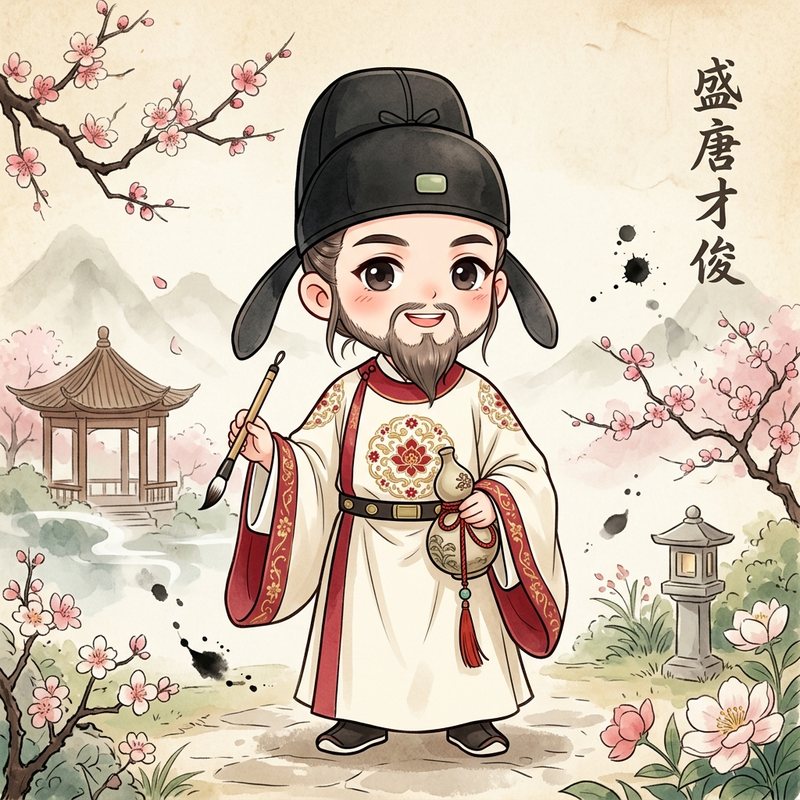
Li Shangyin
Tang Dynasty(812–858)Age 0 · Henei Birthplace“The Romantic Soul of Late Tang: master of untitled poetry who wove mystery, longing, and sublime elegance into timeless verses.”
The Complete Life Journey & Biography of Li Shangyin (Late Tang Poet) (李商隐)
Chronological travel & exile routes mapped to modern Chinese cities across Tang Dynasty China — featuring bilingual scholar audio, classical poetry recitations, and historical cross-paths.
Luoyang Mentorship (东都洛阳)
Age 17829 CEModern-day analog: Eastern capital and literary gathering grounds, modern Luoyang, Henan
Mentored by Prime Minister Linghu Chu in parallel prose, winning fame across Luoyang and earning high praise from Bai Juyi.
In the blooming eastern capital of Luoyang, Li Shangyin met Linghu Chu, the mentor who transformed his life. Treating him like a son, Linghu Chu instructed him in exquisite parallel prose and funded his imperial examinations. Renowned literati praised the young scholar, and the elder giant Bai Juyi was thoroughly captivated. Amid Luoyang's blossoms and music, Li enjoyed the most radiant days of his youth.
“Your immense benevolence reaches far beyond the azure clouds; my humble self stands unburdened beside the boundless sea.”
恩重青云外,身轻沧海边。(Ēn zhòng qīng yún wài, shēn qīng cāng hǎi biān.)Chang'an Examination Triumph (长安及第)
Age 25837 CEModern-day analog: Imperial capital examinations hall, modern Xi'an, Shaanxi
Passing the Jinshi examination at twenty-five, but losing his beloved mentor Linghu Chu in the same tragic winter.
Chang'an's imperial pavilions and Qujiang blossoms witnessed Li Shangyin's triumph at twenty-five, passing the Jinshi examination. Years of hard study had yielded sweet fruit. Yet fate delivered a cruel blow: that very winter, his mentor Linghu Chu died. Without hesitation, the young graduate rode thousands of miles to mourn at the bier. The collision of triumph and sorrow set the tone for his tumultuous life.
“A decade spent grinding a single blade, now at last stepping forth into the azure clouds.”
十年磨一剑,从此踏青云。(Shí nián mó yī jiàn, cóng cǐ tà qīng yún.)Jingzhou Marriage & Factional Rift (甘肃泾州)
Age 26838 CEModern-day analog: Frontier garrison on Silk Road trail, modern Jingchuan, Gansu
Marrying his devoted wife on the frontier, yet unwittingly caught in the vicious crossfire of late Tang factional warfare.
Amid frontier watchtowers in Jingzhou, Li Shangyin found the true love of his life. His father-in-law admired his scholarship, and his wife Wang Yanling was gentle and cultivated. Yet this union sparked personal tragedy. In the late Tang court, the Niu and Li factions were locked in mortal combat. The innocent poet did not realize that by marrying Wang's daughter, he became branded as a traitor, caught between colliding waves.
“Last night's stars, last night's gentle wind, west of the painted pavilion, east of the cassia hall. Although my body lacks colorful phoenix wings to fly to you, our hearts are joined like the single spiritual streak within the sacred horn.”
昨夜星辰昨夜风,画楼西畔桂堂东。身无彩凤双飞翼,心有灵犀一点通。(Zuó yè xīng chén zuó yè fēng, huà lóu xī pàn guì táng dōng. Shēn wú cǎi fèng shuāng fēi yì, xīn yǒu líng xī yī diǎn tōng.)Chang'an Palace Library & Hongnong (长安秘书省)
Age 30842 CEModern-day analog: Imperial secretariat archives in modern Xi'an, Shaanxi
Defying superiors to protect innocent prisoners in Hongnong, and penning the biting political satire 'Jia Sheng' in Chang'an.
Serving as Lieutenant of Hongnong, the gentle poet displayed an unbending backbone. When senior officials forced false confessions on innocent peasants, he slammed his desk and resigned rather than sign death warrants. Relegated to dusty library archives in Chang'an, he observed imperial infatuation with Daoist sorcery and penned 'Jia Sheng': 'Pity that at midnight the emperor leaned forward in vain, asking not about the people, but about ghosts and spirits!'
“In the Xuan Chamber seeking talent, the emperor consulted the banished exile; scholar Jia's genius was beyond compare. Pity that at midnight the emperor leaned forward in vain, asking not about the suffering people, but about ghosts and spirits.”
宣室求贤访逐臣,贾生才调更无伦。可怜夜半虚前席,不问苍生问鬼神。(Xuān shì qiú xián fǎng zhú chén, Jiǎ Shēng cái diào gèng wú lún. Kě lián yè bàn xū qián xí, bù wèn cāng shēng wèn guǐ shén.)Guizhou Karst Sojourn (广西桂州)
Age 35847 CEModern-day analog: Karst limestone mountains along Li River, modern Guilin, Guangxi
Traveling thousands of miles south to serve as secretary in Guilin, distilling delicate poetic longing amid karst river valleys.
Under political turmoil, Li Shangyin bid farewell to his wife and children to journey south to Guilin. The sheer karst peaks and emerald waters of the Li River consoled the exiled poet's lonely spirit. As secretary, he performed his duties diligently; in spare hours, he drifted upon clear waters watching mist shift across jagged crags. Southern breezes washed away heavy ambitions, turning adversity into translucent lyrical beauty.
“Dwelling over misty waters day and night, overcast clouds and dawn glows gather and disperse. Clouds wrap round ancient river stones, while gentle breezes flutter strands of floating green algae.”
水宿淹晨暮,阴霞屡兴歇。云抱积石圆,风牵绿藻发。(Shuǐ xiù yān chén mù, yīn xiá lǚ xīng xiē. Yún bào jī shí yuán, fēng qiān lǜ zǎo fā.)Xuzhou Headquarters & Bereavement (江苏徐州)
Age 38850 CEModern-day analog: Northern martial fortress along Grand Canal, modern Xuzhou, Jiangsu
Learning in Xuzhou of his beloved wife's sudden death in Chang'an, pouring inconsolable grief into immortal elegies.
In the military camp of Xuzhou, Li Shangyin was drafting documents when a letter from Chang'an arrived like a thunderclap: his wife Wang Yanling had passed away. Hundreds of miles separated them; he could not hold her cold hand or hear her final words. She was the one soul who understood his purity and sorrow, now gone forever. Resigning immediately, he hurried back to Chang'an, weeping over her belongings. In raw grief, his love was forged into eternal verse.
“The spring silkworm spins silk until it dies; the candle turns to ash before its tears dry.”
春蚕到死丝方尽,蜡炬成灰泪始干。(Chūn cán dào sǐ sī fāng jìn, là jù chéng huī lèi shǐ gān.)Zizhou Sanctuary & Poetic Summit (四川梓州)
Age 39851 CEModern-day analog: Misty river valleys of Ba-Shu mountain redoubt, modern Santai, Sichuan
Finding refuge under Liu Zhongying in Sichuan, composing 'Night Rain' and 'The Inlaid Zither' amid mountain downpours.
Surrounded by Sichuan's misty mountains in Zizhou, Li Shangyin finally found a sanctuary for his soul. Military Commissioner Liu Zhongying treated him as a cherished confidant, granting him retreat in mountain monasteries to read Buddhist scriptures. Outside, relentless autumn rain filled the pools; inside, oil lamps illuminated a fifty-stringed zither. Here he united a lifetime of displacement, memory, and existential meditation into 'The Inlaid Zither'. All suffering was transfigured into immortal beauty.
“You ask the date of my return, but no date is set; night rain on Mount Ba swells the autumn pools. When shall we trim the candle by the west window together, and talk once more of the night rain on Mount Ba?”
君问归期未有期,巴山夜雨涨秋池。何当共剪西窗烛,却话巴山夜雨时。(Jūn wèn guī qī wèi yǒu qī, Bā shān yè yǔ zhǎng qiū chí. Hé dāng gòng jiǎn xī chuāng zhú, què huà Bā shān yè yǔ shí.)In-Depth Inquiries at this Stop:Chang'an Leyou Plain Sunset (长安乐游原)
Age 43855 CEModern-day analog: Leyou Plateau scenic heights, modern Xi'an, Shaanxi
Returning as Salt and Iron Judicatus, ascending Leyou Plain at dusk to utter the immortal lament on the fading Tang empire.
After decades of wandering, Li Shangyin returned to Chang'an. But the capital was no longer the vibrant metropolis of his youth. At dusk in the chill autumn wind, he climbed Leyou Plain alone in his carriage. As far as the eye could see, the setting sun bathed the majestic ancient city in tragic golden red. He sensed the irreversible sunset of the Tang civilization: 'The setting sun glows with boundless beauty, only it is so close to twilight.' It was the final elegy of a golden age.
“Towards evening, feeling unsettled in spirit, I drove my carriage up to the ancient plateau. The setting sun glows with boundless beauty, only it is so close to twilight.”
向晚意不适,驱车登古原。夕阳无限好,只是近黄昏。(Xiàng wǎn yì bù shì, qū chē dēng gǔ yuán. Xī yáng wú xiàn hǎo, zhǐ shì jìn huáng hūn.)Zhengzhou Resting Place (郑州荥阳)
Age 46858 CEModern-day analog: Ancestral farmsteads of the Central Plains, modern Zhengzhou, Henan
Retiring in ill health to his ancestral home in Zhengzhou, passing away quietly while his manuscripts became immortal classics.
In his ancestral home south of the Yellow River in Zhengzhou, Li Shangyin spent his final peaceful days. Across forty-six tumultuous years, he had struggled in factional strife, grieved the loss of his wife, and attained enlightenment amid mountain rains. On his sickbed, with serene calm, he laid down his brush. Earthly slander and neglect faded with the wind; but his verse, infused with tears and genius, ascended as luminous constellations in the night sky of civilization.
“Could this feeling have waited to become a cherished memory? Even then, in the very moment, all was bewilderment and wonder.”
此情可待成追忆,只是当时已惘然。(Cǐ qíng kě dài chéng zhuī yì, zhǐ shì dāng shí yǐ wǎng rán.)
Literati Knowledge Vault · 先贤知识宝库
In-Depth Essays & Philosophical Inquiries on Li Shangyin
Deep dives, myth-busting, and modern psychological lessons from Li Shangyin's life and philosophy.
Historical Nexus & Intersecting Journeys
与 李商隐 (Li Shangyin) 时空交汇、思想交锋或命运相连的华夏先贤网络
Historical Nexus & Intersecting Journeys
与 李商隐 时空交汇、思想交锋或命运相连的华夏先贤网络
Bai Juyi
白居易
Deeply praised by Bai Juyi in youth; synthesized Tang verse into sublime symbolic and metaphysical depths.
早年深得白居易爱赏,其朦胧深邃之文心与白居易明朗通达之乐府形成晚唐最动人互补。
Du Mu
杜牧
Crowned as the Small Li-Du of late Tang, singing heartrending lyrics against the sunset of imperial decline.
并称'小李杜',在晚唐大厦将倾之际,杜牧以俊爽悲慨讽世,李商隐以沉郁幽微抒怀。
Key Historical Inquiries & Context
关于 李商隐 (Li Shangyin) 的核心史实考证、公案辨析与中英直答
Who was Li Shangyin?
Li Shangyin (c. 813–858 CE) was a major late Tang Dynasty poet known alongside Du Mu as "Little Li and Du". His poetry is famous for intricate symbolism, emotional depth, and allusive romantic melancholy.
Why are Li Shangyin's poems called "Untitled"?
Many of Li Shangyin's most famous romantic and political poems are titled "Untitled" (无题, Wuti) because they convey guarded secrets, forbidden court romances, or dangerous political allegories in an era of deadly factional strife.