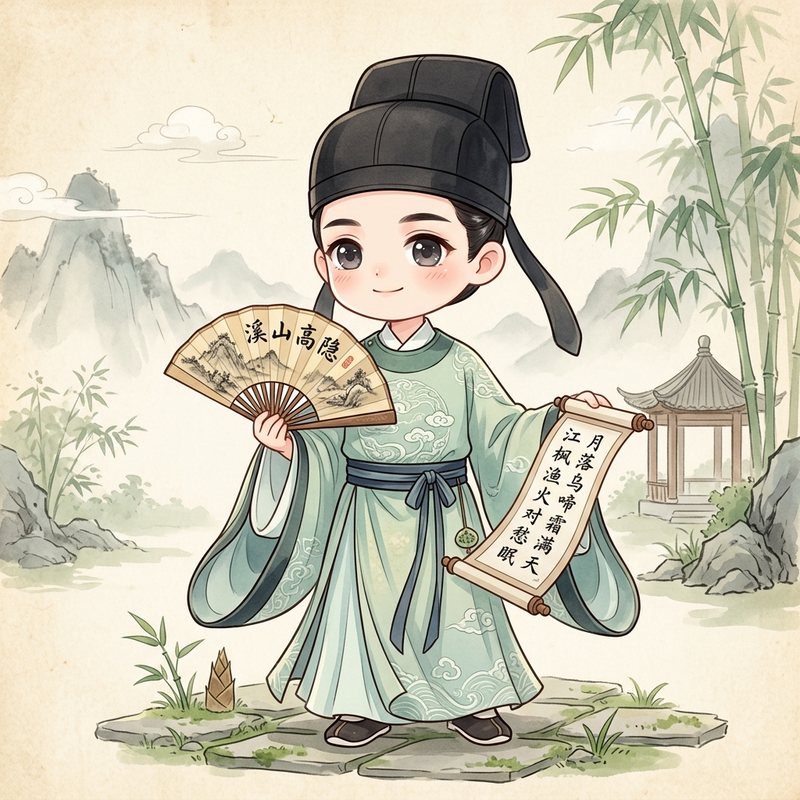
Zhou Dunyi
Northern Song Dynasty(1017–1073)Age 0 · Daozhou Birthplace“Founder of Neo-Confucianism and author of 'On the Love of the Lotus', who unified cosmology with moral integrity.”
The Complete Life Journey & Biography of Zhou Dunyi (Neo-Confucian) (周敦颐)
Chronological travel & exile routes mapped to modern Chinese cities across Northern Song Dynasty China — featuring bilingual scholar audio, classical poetry recitations, and historical cross-paths.
Danyang Filial Mourning (润州丹阳守丧)
Age 151032 CEModern-day analog: Grand Canal transportation hub in the Yangtze Delta, modern Danyang, Jiangsu
Orphaned in youth beside the bustling Grand Canal, Zhou observed strict mourning and buried himself in the Book of Changes.
Beside the bustling Grand Canal at Danyang, boats laden with silks and grain glided past day and night. Yet inside a solitary thatch hut nearby, fifteen-year-old Zhou Dunyi lived an ascetic life of deep mourning and intense study. Rather than succumbing to sorrow over his mother's death, he channeled his grief into decoding the cosmic mysteries of the Book of Changes. By lamplight through winter chills and summer humidity, he read the classics hundreds of times. These three quiet years forged the intellectual bedrock of his philosophy.
“Devoted in learning and sincere in action, his aspirations were firmly anchored in the wisdom of the ancient sages.”
笃学敦行,志存圣贤。(Dǔ xué dūn xíng, zhì cún shèng xián.)Fenning Magistrate Assistant (洪州分宁主簿)
Age 231040 CEModern-day analog: Mountain valley county on the Xiu River in northwestern Jiangxi, modern Xiushui
Appointed rookie assistant magistrate in Fenning, Zhou solved complex years-old cold cases in a single morning.
Inside the dim judicial chambers of Fenning along the Xiu River, musty court records had gathered dust for years. Taking his seat as assistant magistrate, 23-year-old Zhou Dunyi faced a labyrinth of conflicting testimonies and corrupt bureaucratic obfuscation. Without resorting to torture, Zhou pinpointed minute contradictions in the transcripts and dismantled the false charges through calm, relentless logic. By noon, the real perpetrators confessed, and innocent prisoners were freed. The young philosopher proved that practical justice was rooted in discerning moral truth.
“Resolving complex litigation with a single piercing inquiry, leaving seasoned clerks and commoners awestruck by his justice.”
一讯立辨,吏民惊服。(Yī xùn lì biàn, lìmín jīngfú.)Nan'an Judicial Standoff (南安军抗酷救囚)
Age 271044 CEModern-day analog: Strategic pass on the Dayu Ridge between Jiangxi and Lingnan, modern Dayu
Hurling his official badge to the floor, Zhou defied a bloodthirsty superior, moving a colleague to entrust his two sons as disciples.
In the mountain garrison of Nan'an beneath Dayu Ridge, transport commissioner Wang Kui glared at his assembled subordinates, demanding an immediate execution order. As terrified officials hung their heads, 27-year-old Zhou Dunyi stood tall. Defying threats of dismissal and imprisonment, he hurled his official ivory tablet to the floor with a resounding crash: 'To murder to curry favor is something I will never do!' Shamed by his moral ferocity, Wang Kui spared the man. Watching in awe, vice governor Cheng Xiang immediately enrolled his sons Cheng Hao and Cheng Yi under Zhou's wing, igniting the torch of Neo-Confucianism.
“How can one remain in office under such conditions! To kill an innocent man merely to curry favor with the powerful is something I will never do!”
如此尚可仕乎!杀人以媚人,吾不为也!(Rú cǐ shàng kě shì hū! Shā rén yǐ mèi rén, wú bù wéi yě!)Guiyang County Magistrate (郴州桂阳知县)
Age 291046 CEModern-day analog: Border county between Hunan and Guangdong in the Nanling Mountains, modern Rucheng
Governing mountainous Guiyang with parental devotion, Zhou dug his first lotus pond and founded local academies.
In the subtropical mountain valleys of Guiyang, Magistrate Zhou Dunyi visited every terraced village. He settled land disputes with empathy and personally lectured at the county academy. Behind the courtroom, his newly excavated pond bloomed with white lotuses, their delicate fragrance drifting into administrative halls. This was the first of Zhou's iconic lotus ponds. Here he merged public service with moral self-cultivation, treating farmers like kin. Locals marveled that their magistrate was indeed like the lotus—rising unblemished above the silt of imperial bureaucracy.
“Governance was tranquil and disputes were equitably reconciled; the common people cherished him as they would their own parents.”
政平讼理,民爱之如父母。(Zhèng píng sòng lǐ, mín ài zhī rú fù mǔ.)Hezhou Cosmological Synthesis (合州通判撰太极图说)
Age 391056 CEModern-day analog: Confluence of Jialing, Qu, and Fu Rivers in eastern Sichuan, modern Hechuan, Chongqing
At the dramatic confluence of three Sichuan rivers, Zhou penned the 250-character Taijitu Shuo, unveiling Neo-Confucian cosmology.
At Hezhou, where the Jialing, Qu, and Fu rivers merged in turbulent rapids, 39-year-old Zhou Dunyi watched the swirling currents from his riverside quarters. By day, he disposed of tangled lawsuits with flawless equity. By night, under dancing candlelight, he completed the 'Taijitu Shuo'. In 250 precise characters, he articulated how the Boundless manifested as the Supreme Ultimate, moving between dynamic Yang and serene Yin to generate heaven, earth, and human conscience. He gave Chinese civilization its definitive metaphysical compass.
“The Boundless, and yet the Supreme Ultimate! The Supreme Ultimate through movement generates yang; at its limit it becomes tranquil, and through tranquility generates yin.”
无极而太极。太极动而生阳,动极而静;静而生阴,静极复动。(Wú jí ér tài jí. Tài jí dòng ér shēng yáng, dòng jí ér jìng; jìng ér shēng yīn, jìng jí fù dòng.)Qianzhou Vice Governor & Dialogue (虔州通判论道)
Age 441061 CEModern-day analog: Major trade fortress at the head of the Gan River, modern Ganzhou, Jiangxi
Meeting the empire's strictest anti-corruption censor in Qianzhou, Zhou won his lifelong devotion after one evening's talk.
In the ancient fortress of Qianzhou where the Zhang and Gong rivers met, Prefect Zhao Bian sat across from 44-year-old Vice Governor Zhou Dunyi. Zhao Bian had terrified corrupt courts as the 'Iron-Faced Censor' and initially suspected Zhou of intellectual arrogance. But as the tea brewed and midnight passed, Zhou explained the harmony between cosmic principle and inner peace. The stern prosecutor rose and gripped Zhou's hand: 'You are a singular genius under heaven!' disciples flocked to study, absorbing the joy of Confucius and Yan Hui.
“Master Zhou Maoshu of Chongling possessed the loftiest character; his heart was open and untrammeled, like a fresh breeze under the sun and the bright moon after rain.”
舂陵周茂叔,人品甚高,胸怀洒落,如光风霁月。(Chōng líng Zhōu Mào shū, rén pǐn shèn gāo, xiōng huái sǎ luò, rú guāng fēng jì yuè.)Guangnan Judicial Commissioner (广南东路提点刑狱)
Age 511068 CEModern-day analog: Capital of the southern maritime circuit and Pearl River Delta, modern Guangzhou, Guangdong
Braving deadly subtropical malaria across Lingnan, Zhou toured remote prisons to liberate hundreds of wrongful captives.
Across the wild subtropical hills of Guangdong in 1068 CE, deadly malaria kept most imperial inspectors locked safely in urban yamens. 51-year-old Zhou Dunyi refused to hide. Wearing a straw raincoat and riding a mountain pony, he inspected every damp county jail across the circuit. By oil lamp in pestilent cellars, he reviewed coerced confessions, overturning wrongful executions and freeing indebted villagers. Struck down by virulent jungle fever, he hovered between life and death on the post road. When urged to turn back, he replied that a sage lives by sincerity and cannot abandon innocent human lives.
“Sincerity is the foundation of the sage. The scholar aspires to become worthy, the worthy aspires to become a sage, and the sage aspires to harmonize with Heaven.”
诚者,圣人之本。士希贤,贤希圣,圣希天。(Chéng zhě, shèng rén zhī běn. Shì xī xián, xián xī shèng, shèng xī tiān.)Nankang Lotus Pond & Masterpiece (南康军知军凿池爱莲)
Age 541071 CEModern-day analog: Scenic lakeside port between Mount Lu and Poyang Lake, modern Lushan City, Jiangxi
Beneath Mount Lu beside Poyang Lake, Zhou dug the famed Ai Lian Pond and penned the immortal 'On the Love of the Lotus'.
Beneath the soaring crags of Mount Lu, the waters of Poyang Lake shimmered in late afternoon sun. 54-year-old Zhou Dunyi stood on the wooden deck of his newly built pavilion beside the lotus pool. After three decades navigating bureaucratic cynicism, judicial battles, and lethal subtropical fevers, his spirit was as tranquil as unruffled spring water. In May 1071, he dipped his brush and inked the immortal 119 characters of 'Ai Lian Shuo': 'I love only the lotus, for it rises from the silt yet remains unstained...' It was not an escapist fantasy, but the hard-won battle cry of a public servant whose moral core remained unblemished.
“I love only the lotus, for it rises from the silt yet remains unstained, and is cleansed by clear ripples yet is not wanton; hollow within and straight without, neither spreading vines nor branching, its fragrance travels far and grows ever purer; standing clean and erect, it can be viewed from afar, but never toyed with profanely.”
予独爱莲之出淤泥而不染,濯清涟而不妖,中通外直,不蔓不枝,香远益清,亭亭净植,可远观而不可亵玩焉。(Yú dú ài lián zhī chū yū ní ér bù rǎn, zhuó qīng lián ér bù yāo, zhōng tōng wài zhí, bù màn bù zhī, xiāng yuǎn yì qīng, tíng tíng jìng zhí, kě yuǎn guān ér bù kě xiè wán yān.)Lianxi Academy & Passing (江州濂溪书堂羽化)
Age 561073 CEModern-day analog: Scholarly retreat beneath Lotus Peak of Mount Lu, modern Lianxi District, Jiujiang
Retiring to Mount Lu's Lotus Peak, Master Lianxi taught disciples in peace until his gentle passing in 1073.
Beneath Lotus Peak at Mount Lu, pines whispered in mountain breezes as a crystal brook rippled past the Lianxi Academy. Wrapped in a plain scholar's robe, 56-year-old Zhou Dunyi smiled as young students gathered eagerly on stone benches. He taught them to seek genuine joy in nature's quiet vibrancy rather than chasing imperial honors. In the summer of 1073, as white lotuses blossomed across his garden pond, Master Lianxi closed his eyes and passed peacefully away. Poet Huang Tingjian immortalized him: 'His character was lofty, his soul open and free, like a fresh breeze under the sun and the bright moon after rain.' The stream of Lianxi had become an eternal river of Chinese wisdom.
“The lotus is the noble gentleman among flowers.”
莲,花之君子者也。(Lián, huā zhī jūn zǐ zhě yě.)
Literati Knowledge Vault · 先贤知识宝库
In-Depth Essays & Philosophical Inquiries on Zhou Dunyi
Deep dives, myth-busting, and modern psychological lessons from Zhou Dunyi's life and philosophy.
暂无已发布的深度专栏文章。
Historical Nexus & Intersecting Journeys
与 周敦颐 (Zhou Dunyi) 时空交汇、思想交锋或命运相连的华夏先贤网络
Historical Nexus & Intersecting Journeys
与 周敦颐 时空交汇、思想交锋或命运相连的华夏先贤网络
Key Historical Inquiries & Context
关于 周敦颐 (Zhou Dunyi) 的核心史实考证、公案辨析与中英直答
Who was Zhou Dunyi (周敦颐)?
Zhou Dunyi (1017–1073), styled Maoshu and known as Master Lianxi, was a native of Daozhou (modern Daoxian, Hunan) and the pioneering patriarch of Song Dynasty Neo-Confucianism, leading the 'Five Masters of the Northern Song'. Throughout his administrative career as magistrate assistant, judicial officer, and imperial commissioner across Jiangxi, Hunan, Sichuan, and Guangdong, he was renowned for razor-sharp legal acumen and unflinching integrity, famously hurling down his tablet of office to save an innocent man from execution. In philosophy, he synthesized the Book of Changes with Daoist cosmology, composing the 'Taijitu Shuo' (Explanation of the Diagram of the Supreme Ultimate) to anchor ethics in cosmic genesis, and the 'Tongshu' to establish Sincerity (Cheng) as the foundation of sagehood. In 1071, he penned 'On the Love of the Lotus' (Ai Lian Shuo), creating East Asia's definitive metaphor for moral purity. Mentoring the Cheng brothers, his legacy was codified by Zhu Xi as the foundational cornerstone of Neo-Confucian civilization.
What was Zhou Dunyi's primary cultural and historical legacy?
Zhou Dunyi is celebrated across world history as a pioneer of Cosmological Architect of Neo-Confucianism, The Lotus Exemplar of Unstained Virtue, The Hermit Philosopher of Mount Lu, leaving enduring philosophical insights, literature, and art.
Where does Zhou Dunyi's historical life journey map lead?
This interactive GIS map retraces 10 chronological stops across Northern Song Dynasty China, originating from Daozhou Birthplace and spanning through Lianxi Academy & Passing.