Who Was Sun Tzu? The Mind Behind Art of War
Beyond boardroom slogans: The dramatic true life of Sun Wu from political exile in Qi to the concubine drill, the Baiju blitzkrieg, and peaceful retreat by Lake Tai
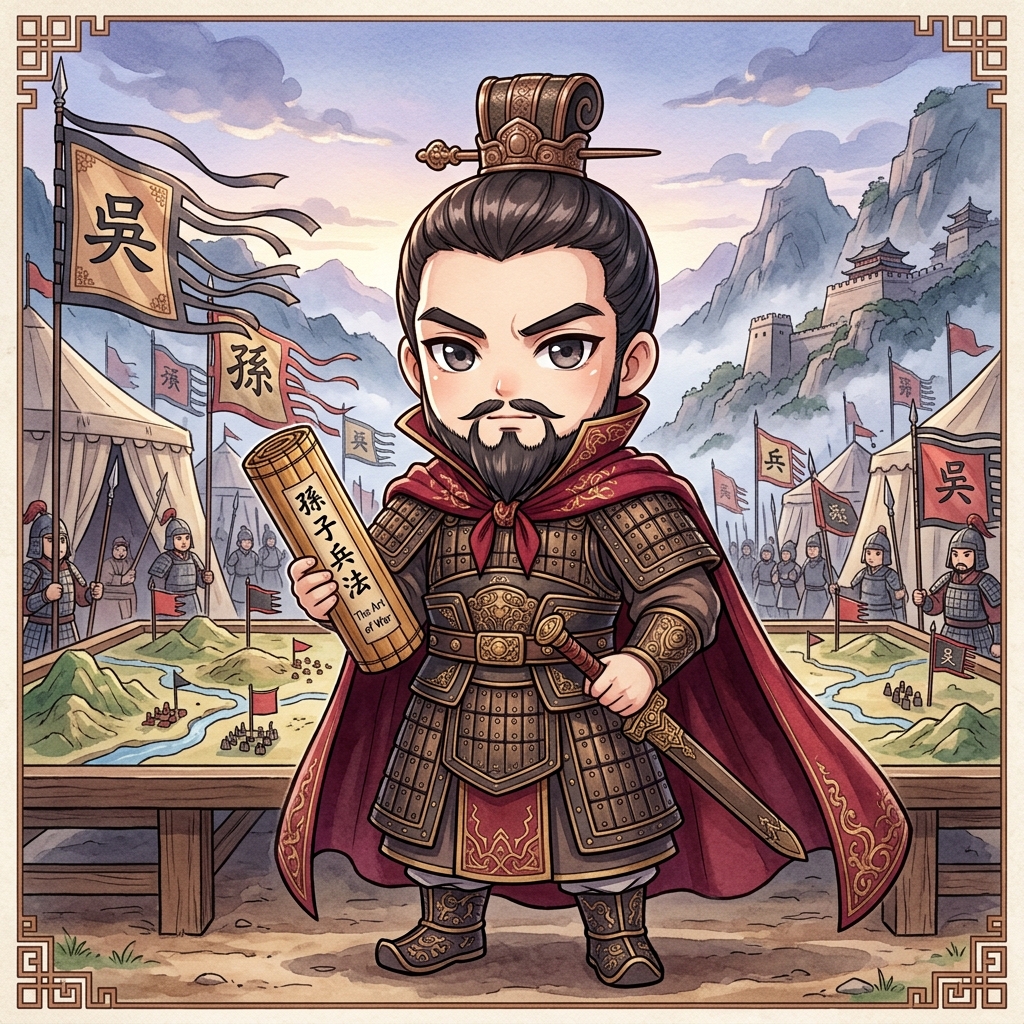
Sun Tzu (Sun Wu) (孙子 (孙武) · Sūn Zǐ)
字长卿 · 兵家至圣 · 百世兵家之师
The Supreme Strategist & Master of The Art of War
兵家鼻祖 · 不战而屈人之兵的东方战略哲学宗师
- Real Identity & Lineage (c. 544–470 BCE): Named Sun Wu (courtesy name Changqing), born into the aristocratic Tian military clan in Qi; fled political purges south across the Yangtze to the State of Wu.
- The Royal Concubine Test: When challenged by King Helü to drill 180 pampered palace maidens, Sun Wu strictly enforced martial law and executed two royal favorites, earning undisputed supreme command.
- The Baiju Masterclass (506 BCE): Led an asymmetric expeditionary force of 30,000, defeated Chu's 200,000-man imperial army across five consecutive victories, and captured the superpower capital Yingdu in 10 days.
- The Supreme Art of Walking Away: Unlike his friend Wu Zixu, who was later executed in court palace intrigues, Sun Tzu practiced his own ultimate doctrine of self-preservation, renouncing all titles to retire quietly by Lake Tai.
Phase 1: Aristocratic Heritage & Mountain Seclusion (c. 544–518 BCE)
Sun Wu was born in Le'an (modern Huimin, Shandong) in the State of Qi, during the fractured Spring and Autumn period. His family belonged to the powerful Chen-Tian lineage, famous for military scholars like Sima Rangju. Growing up surrounded by classical tactical archives, the young Sun Wu observed the chaos of warring feudal lords and realized that raw brute force was an expensive path to ruin.
孙武出生于齐国乐安(今山东惠民)。其家族源出陈完后裔田氏贵族,世代知兵,深受司马穰苴等兵学先贤熏陶。目睹诸侯争霸生灵涂炭,年轻的孙武很早便领悟到:纯粹依赖武力厮杀乃是劳民伤财的下下之策。
兵者,国之大事,死生之地,存亡之道,不可不察也。
Bīng zhě, guó zhī dà shì, sǐ shēng zhī dì, cún wáng zhī dào, bù kě bù chá yě.
Military action is of vital importance to the State; it is a matter of life and death, a road either to safety or to ruin. Hence it is a subject of inquiry which can on no account be neglected.
Context · The solemn opening sentence of The Art of War, highlighting the supreme responsibility of leadership.
When civil war erupted among the rival clans of Qi around 518 BCE, Sun Wu refused to partake in the factional bloodbath. He packed his bamboo scrolls and embarked on an 800-kilometer southward migration across the Yangtze River into the semi-wild southern kingdom of Wu. On the tranquil, forested slopes of Mount Qionglong near modern Suzhou, he lived as an ascetic hermit, distilling centuries of warfare into the immortal 13 chapters of The Art of War.
公元前518年左右齐国内乱爆发,孙武不愿卷入贵族倾轧,携带兵书渡过长江南下吴国。在苏州郊外的穹窿山深处结庐隐居,将天地万物之理与战场人性博弈熔于一炉,著就传世的兵法十三篇。
Phase 2: The Royal Concubine Test & Supreme Command (512 BCE)
In Wu, Sun Wu befriended another prominent refugee: Wu Zixu, a brilliant Chu statesman seeking revenge for his murdered family. Recognizing Sun Wu's genius, Wu Zixu recommended him to King Helü seven separate times. Skeptical of theoretical treatises, the king challenged Sun Tzu: 'Can your principles of discipline and maneuver be applied to anyone—even my court women?'
在吴国,孙武结识了楚国流亡名臣伍子胥。伍子胥深感孙武之奇才,向吴王阖闾七次力荐。吴王翻阅兵书后半信半疑,发问道:‘卿之十三篇,孤尽观之矣。可以小试勒兵乎?妇人可否?’
Sun Tzu accepted. King Helü assembled 180 of his favorite concubines, appointing his two most cherished consorts as company commanders. Sun Tzu patiently explained the drum commands three times and demonstrated the turns five times. Yet when the war drums rolled, the maidens simply broke into uncontrollable giggles.
孙武坦然应允。阖闾挑选宫中美女一百八十人,以吴王最宠爱的两位爱姬为队长。孙武三令五申,再三讲明进退规程。然而战鼓一响,深宫嫔妃嬉笑成群,全无军纪。
Sun Tzu declared with unyielding solemnity: 'If rules are not clear, it is the general's fault. But when orders have been repeated clearly and are still disobeyed, it is the crime of the officers.' He immediately ordered the execution of the two royal favorites. Despite frantic royal pleas from King Helü, Sun Tzu replied: 'Having received the general's commission in the field, there are commands of the sovereign which I cannot accept.' The concubines were executed, and the remaining 178 women drilled in absolute, terrifying precision. King Helü realized he was dealing with a master of destiny and appointed him Grand Commander.
孙武肃容严正道:‘约束不明,申令不熟,将之罪也;既已明而不如法者,吏士之罪也。’当即下令按军法将两位爱姬斩首。吴王急忙登台求情,孙武慨然回答:‘臣既已受命为将,将在军,君命有所不受!’斩杀二姬后,校场肃杀无声,百八宫女进退坐作如臂使指。吴王虽痛惜爱妾,却深知得遇旷世神将,遂拜孙武为三军大都督。
Phase 3: The Baiju Masterclass & Defeating Chu (506 BCE)
In 506 BCE, King Helü and Sun Tzu launched their grand campaign against the State of Chu, the southern superpower of ancient China. While Chu marshaled an army exceeding 200,000 soldiers, Wu fielded only 30,000. Conventional wisdom would have dictated a cautious defensive posture. Sun Tzu did the exact opposite.
公元前506年,吴王阖闾与孙武统兵伐楚。楚国乃春秋南方第一大国,常备甲士达二十万;而吴军仅精兵三万人。以弱敌强,常规战法必取自守,而孙武却施展了一场人类古代战争史上极具开创性的不对称闪电战。
Using deception, Sun Tzu abandoned his transport boats along the Huai River, marched his elite troops across mountain passes where Chu least expected them, and appeared suddenly on the plains of Baiju (modern Macheng, Hubei). In five rapid, coordinated strikes, Sun Tzu dissected Chu's supply lines and command cohesion. Within ten days of entering Chu territory, the Wu army breached the gates of Yingdu (modern Jingzhou), forcing the Chu king to flee. It was the first time in history that a southern barbarian border state overthrew China's dominant regional superpower.
孙武深谙‘避实击虚’之道,舍舟登陆,出其不意穿插千里奇袭大别山隘口,直扑柏举(今湖北麻城)。五战五捷,以少胜多,十日之内直捣楚都郢都(今湖北荆州),迫使楚昭王仓皇出逃。此役震惊天下诸侯,彻底颠覆了春秋列国的政治霸业版图。
| Perspective 视角 | Dimension | Pop Culture Myth vs. Historical Reality |
|---|---|---|
| Core Purpose of War | Crushing enemies with deceit & tricks (Hollywood view) | Preservation of the state & winning without fighting (Actual doctrine) |
| Role in Battle | An armchair academic philosopher sipping tea | Active field general marching on foot in extreme combat (Baiju & Yingdu) |
| Authorship Date | Late Warring States forgery (older 20th c. skepticism) | Confirmed late Spring & Autumn by 1972 Yinqueshan bamboo slip discoveries |
| Sun Tzu vs. Sun Bin | Often confused as the same disabled strategist | Sun Wu is the Spring & Autumn ancestor; Sun Bin is his descendant 150 years later |
| Final Fate | Executed or vanished into obscurity | Recognized political danger, gracefully retired to Lake Tai to live out natural life |
Phase 4: The Hegemony of Gusu & Graceful Retirement (c. 496–470 BCE)
After returning in triumph, Sun Tzu assisted King Helü and Wu Zixu in designing the master city layout of Gusu (ancient Suzhou). They instituted the famous 'dual chessboard' urban design of parallel water canals and land streets, transforming Wu into an economic fortress.
班师还朝后,孙武协助吴王与伍子胥规划筑造姑苏大城(今苏州)。他们开创性地设计了水陆并行的‘双棋盘’城市格局,引水入城,固若金汤,使吴国迅速跃升为春秋五霸之一。
However, the peak of success harbored deep peril. When King Helü died from battle wounds in 496 BCE, his son Fuchai succeeded the throne. Fuchai grew vain, ignored sound counsel, and eventually forced Wu Zixu to commit suicide with an imperial sword. Having observed the tragic cycles of court jealousy, Sun Tzu enacted his own supreme doctrine: 'The skillful strategist positions himself in an invulnerable place.' He surrendered his seals of office, rejected royal rewards, and sailed quietly into the mist-veiled waters of Dongting Mountain on Lake Tai.
然而登顶之日,正是危局潜藏之时。公元前496年吴王阖闾伤重去世,继位的夫差骄奢淫逸、听信谗言,最终赐剑逼死伍子胥。早已参透盛衰规律的孙武深知‘飞鸟尽良弓藏’,果断践行自己兵法中的无上哲学:‘立于不败之地’。他辞去高官显爵,不受寸土封赏,扁舟一叶隐入太湖东洞庭山的烟波之中,修身著书,得享天年。
Trace Sun Tzu's Real Footprints across Ancient China
Step beyond the text and follow Sun Wu's authentic 8-station journey—from Qi exile and the Suzhou mountain hut to the Baiju blitzkrieg and Lake Tai retreat—on our interactive 3D terrain map with synchronized audio.
Launch 3D Expedition MapFrequently Asked Questions (People Also Ask)
Did Sun Tzu actually exist, or was he made up?
Sun Tzu was a real historical person named Sun Wu (c. 544–470 BCE). Skeptics historically questioned his existence until the 1972 Yinqueshan Han tomb excavation in Shandong unearthed ancient bamboo slips containing both Sun Tzu's Art of War and his great-grandson Sun Bin's Military Art, proving conclusively that both were real, distinct historical generals.
How did Sun Tzu die?
Unlike his companion Wu Zixu, who was tragically executed by King Fuchai, Sun Tzu retired peacefully from court politics around 484 BCE. He lived out his remaining years quietly by Lake Tai in southern Jiangsu, passing away of natural causes around age 74 in c. 470 BCE.
What is the difference between Sun Tzu and Sun Bin?
Sun Tzu (Sun Wu) lived during the late Spring and Autumn period (c. 500 BCE) and authored the foundational 13 chapters of The Art of War. Sun Bin was his direct descendant living 150 years later during the Warring States period, famous for losing his kneecaps to a jealous rival and winning the Battle of Maling from a carriage.
What is the main message of The Art of War?
The paramount message of The Art of War is that physical conflict is an admission of strategic failure. True victory lies in preparation, deception, information asymmetry ('know yourself and know your enemy'), and breaking the opponent's will and capacity to resist without ever fighting a battle.
Walk with Sun Tzu (Sun Wu) Across China
随孙子 (孙武)漫步华夏河山 · 亲历命运逆境与精神涅槃