Who Was Guan Yu? Was He Real & Why Is He God of War?
Who Was Guan Yu? Was He Real & Why Is He God of War?
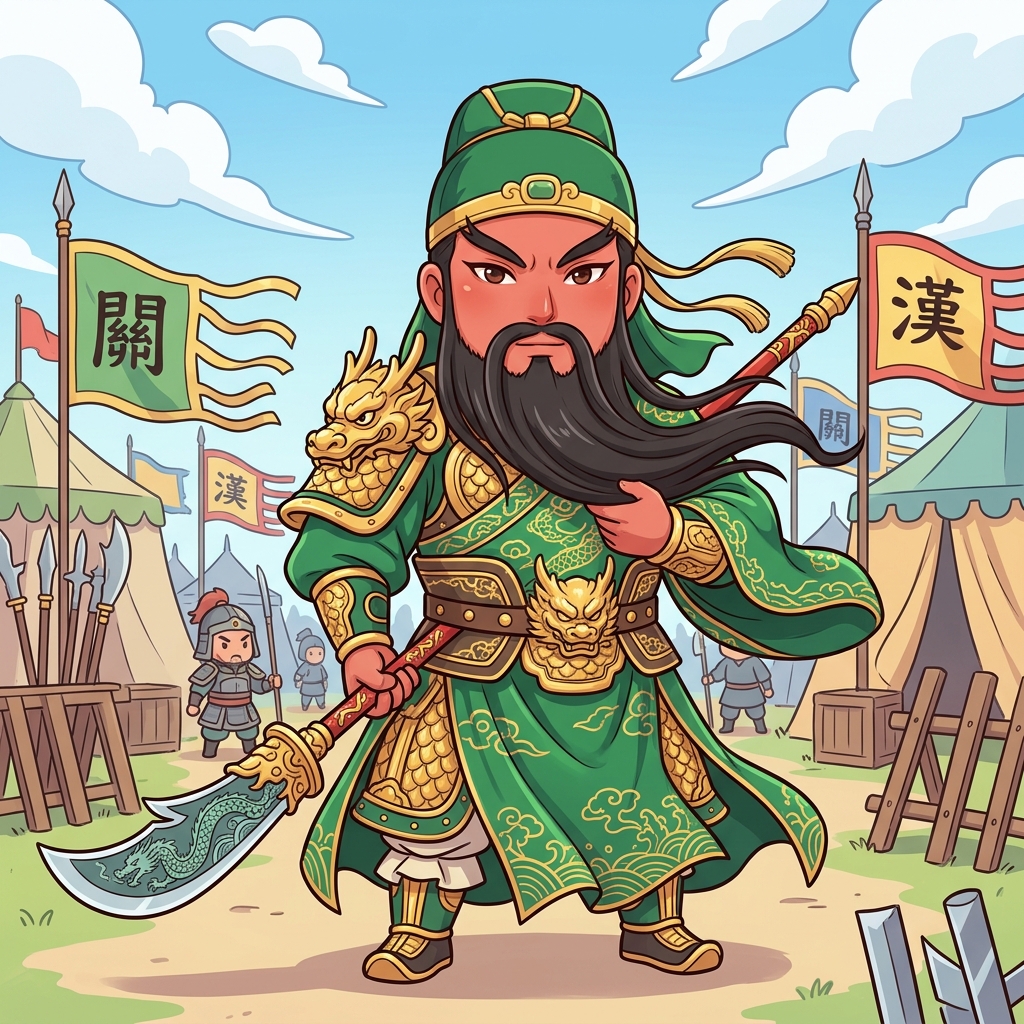
Guan Yu (Lord Guan) (关羽 (关云长) · Guān Yǔ)
字云长 · 汉寿亭侯 · 关圣帝君
China's Martial Saint & Sovereign Exemplar of Unbreakable Brotherhood and Honor
威震华夏之武圣 · 义薄云天挂印单骑的万世信义图腾
- Historical Identity: Celebrated general of Shu Han during the Three Kingdoms Period, posthumously deified as China's 'Martial Saint' (武圣) beside Confucius.
- Fugitive Turned Hero: Born by the inland salt lake in Xiezhou, he slew a local tyrant and fled north, forming the legendary brotherhood with Liu Bei and Zhang Fei.
- Incorruptible Honor: Slew general Yan Liang in single combat to repay Cao Cao's hospitality, then sealed all gold gifts and rode away to find his brother.
- Patron of Wealth & Trust: Revere-worshipped by merchants worldwide as a god of commerce because his word was unbreakable, representing commercial integrity.
The Fugitive from the Inland Salt Lake
Historical records confirm that Guan Yu was born in Xiezhou near China's great inland salt lake (modern Shanxi Province). Standing six feet four inches tall with a magnificent two-foot beard, he was extraordinarily powerful and loved reading ancient history. When corrupt gentry bullied helpless townsfolk, young Guan Yu slew the abusive tyrant and fled north as a fugitive.
In Zhuozhou, he met Liu Bei and Zhang Fei. The trio forged an unbreakable oath of brotherhood, sleeping on the same bed and standing side by side through defeat and exile, beginning one of the greatest military epics in Asian history.
Untempted by Empire: Repaying Cao Cao with Yan Liang's Head
In 200 CE, when Liu Bei's forces were routed, Guan Yu surrendered conditionally to Cao Cao to protect Liu Bei's family. Cao Cao showered Guan Yu with high imperial ranks, silver, and banquets, hoping to win his permanent allegiance. Yet Guan Yu plainly stated that his heart belonged only to his brother:
吾极知曹公待我厚,然吾受刘将军厚恩,誓以共死,不可背之。 吾终不留,吾要当立效以报曹公乃去。
Wú jí zhī Cáo gōng dài wǒ hòu, rán wú shòu Liú jiāng jūn hòu ēn, shì yǐ gòng sǐ, bù kě bèi zhī. Wú zhōng bù liú, wú yào dāng lì xiào yǐ bào Cáo gōng nǎi qù.
I know full well how generously Lord Cao treats me. Yet I received deep favors from General Liu and swore to die with him; I cannot betray this. I shall not remain here, but I must achieve a great deed to repay Lord Cao before I depart.
Context · Recorded in Sima Guang's Zizhi Tongjian and Chen Shou's Records of the Three Kingdoms — An unmatched declaration of honor.
At the Battle of Baima, spotting commander Yan Liang's canopy across the lines, Guan Yu spurred his horse into the heart of the enemy host alone, decapitated Yan Liang in broad daylight, and rode out untouched. Having repaid his moral debt in blood, he sealed all of Cao Cao's gifts, declined honors, and rode across northern China to rejoin his penniless brother.
Flooding the Seven Armies: The Zenith at Fancheng
Assigned supreme military command over Jingzhou for a decade, Guan Yu fortified Jiangling into an impregnable naval bastion. In 219 CE, he launched a massive northern offensive against Fancheng. When autumn monsoon rains caused the Han River to overflow, Guan Yu navigated warships across the plains, drowning and capturing General Yu Jin's seven elite armies and terrifying Cao Cao into contemplating moving the imperial capital.
| Perspective 视角 | Dimension | Guan Yu (Martial Saint) vs. Greek God of War (Ares) |
|---|---|---|
| Core Virtue | Absolute fidelity, righteousness (Yi), moral incorruptibility, and protection of the innocent | Brutal bloodlust, chaotic violence, battlefield slaughter, and physical brutality |
| Historical Reality | A verified mortal commander of the 3rd century whose exceptional honor led to spiritual deification | A mythological Olympic deity personifying the untamed destructive frenzy of combat |
| Commercial Reverence | Worshipped by modern merchants worldwide as the Patron of Wealth, Trust, and Fair Contracts | Feared by ancient Greek city-states and rarely given public worship by peaceful citizens |
| Sunset and Legacy | Betrayed from behind by allies, refused surrender, and died with heroic dignity at Maicheng | Immortal, but frequently humiliated or outsmarted by Athena and mortals in epic poetry |
Trace Guan Yu's 12 Strategic Campaign Stations Across China
Follow Guan Yu's epic life trajectory — from his youth in Xiezhou and the Peach Garden Oath to the charging plains of Baima and the historic naval flood of Fancheng on our interactive 3D map.
Launch Guan Yu's Odyssey MapFrequently Asked Questions (People Also Ask)
Was Guan Yu a real historical person?
Yes. Guan Yu (d. 220 CE) was a real general of Shu Han documented in Chen Shou's Records of the Three Kingdoms (Sanguozhi). While Romance of the Three Kingdoms embellished his feats, his brotherhood with Liu Bei and battlefield prowess are authentic history.
What is Guan Yu's Chinese name and title?
His name in Chinese is 关羽 (Guān Yǔ), courtesy name Yunchang (云长). Deified titles include Guandi (关帝, Emperor Guan), Guan Gong (关公, Lord Guan), and Martial Saint (武圣).
Why is Guan Yu worshipped as China's God of War?
Unlike Ares or Mars who embody bloodlust and slaughter, Guan Yu (d. 220 CE) is venerated as China's Martial Saint (武圣) because of 'Yi' (义)—unshakable loyalty, moral righteousness, and honor. His deification began in the Tang dynasty and peaked in the Qing dynasty, when thousands of temples honored him beside Confucius.
Why do businesses and merchants worship Guan Yu as a God of Wealth?
Guan Yu embodies unbreakable trust and integrity. In traditional Chinese commerce, a partner's word was worth more than gold. Business owners honor Guan Yu to signify honest accounting, loyalty among partners, and protection against commercial fraud.
Did Guan Yu really wield the 82-pound Green Dragon Crescent Blade?
The Green Dragon Crescent Blade (Yanyuedao) was popularized by the 14th-century novel Romance of the Three Kingdoms. In authentic 3rd-century history, Guan Yu fought with standard Han cavalry spears (Mao) and swords (Dao).
How did Guan Yu die?
In 219 CE, while Guan Yu was besieging Fancheng, his ally Eastern Wu launched a surprise rear attack and captured Jingzhou. Cut off from supplies, Guan Yu retreated to Maicheng, was captured in ambush, and was executed in early 220 CE.