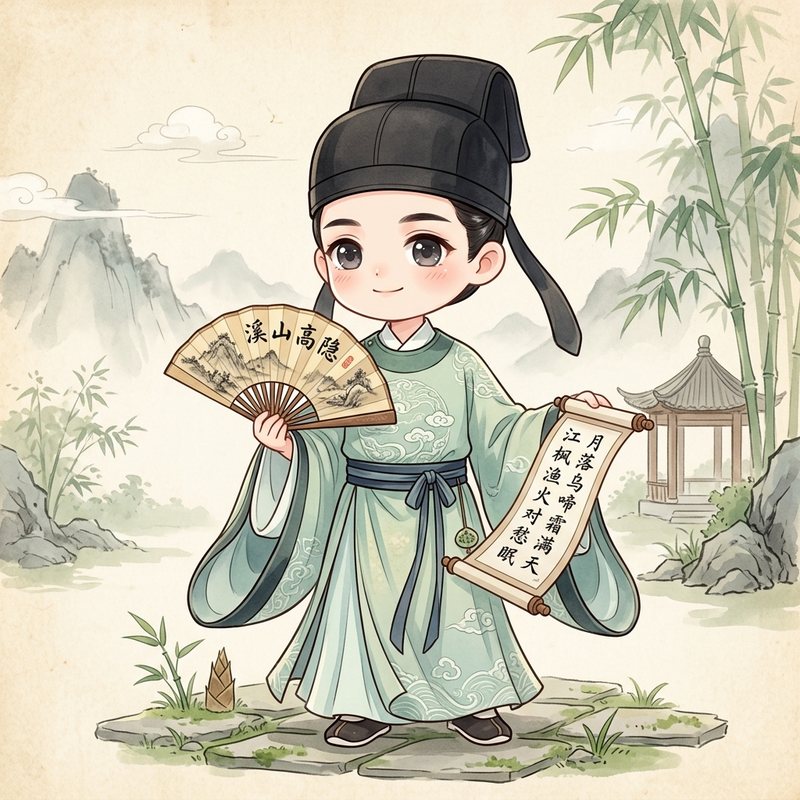
Master of Slow-Tune Lyrics & Folk Minstrel · 987 – 1053
The supreme master of the Graceful and Restrained lyric school and father of the slow tune (manci), who gave voice to commoners and lovers across imperial China.
Stops10
Traversed~5,373km
Audio Tour~12min
“才子词人,自是白衣卿相。”
A gifted scholar and lyric poet is, by his very nature, a peer of high chancellors in common white cloth.
Master of Slow-Tune Lyrics & Folk MinstrelSong Dynasty(987—1053)字耆卿 · 原名三变 · 世称柳屯田Audio Journey · 10 Stops
The supreme master of slow-tune lyric poetry who gave voice to commoners and lovers across imperial China.
The Song Dynasty Robert Burns· Robert BurnsThe Architect of the Slow Tune· Pioneer of extended balladryThe Sovereign's Defiant Minstrel· The Bohemian rebel
Unfolding the Historical Landscape…
印
Daily Wisdom & Resilience Oracle
The Resilient Optimist
“竹杖芒鞋轻胜马,谁怕?一蓑烟雨任平生。”
Holding a bamboo cane and wearing straw sandals, I stride faster than a horse. Who is afraid? A straw cloak in the mist and rain — I live my life with equanimity.
💡 In the 3rd year of exile in Huangzhou, caught in a sudden downpour, Su Shi embraced the storm with supreme resilience.
— Su Shi (Dongpo)(The Renaissance Foodie & Optimist)
Historical Footprints & Narration Archive
10 Stations
1
Chong'an (Wuyishan), Fujian
987 CE · Age 0
Cradle of tea culture and rocky peaks of Mount Wuyi, modern Wuyishan, Fujian
Born into a scholarly lineage among Mount Wuyi's peaks, young Liu Yong mastered both classical texts and melodic verse.
“才子词人,自是白衣卿相。”
Cái zǐ cí rén, zì shì bái yī qīng xiàng.
A gifted scholar and lyric poet is, by his very nature, a peer of high chancellors in common white cloth.
Station Narration Script
In 987 CE, Liu Yong was born into a distinguished scholar-official family beneath Mount Wuyi in Chong'an. Brilliant from boyhood, he mastered classical texts and musical rhythms, absorbing the natural splendor that would nourish his poetic genius.
Departure Transition Script
With his early studies completed, young Liu Yong bid farewell to his mountain home to seek imperial office in the north.
2
Qiantang (Hangzhou), Zhejiang
1003 CE · Age 17
Flourishing canal metropolis and West Lake scenic center of the southeastern Song realm
Arriving in scenic Hangzhou, he composed 'Watching the Sea Tide', dazzling the southeastern realm with his lyric brilliance.
“重湖叠巘清嘉,有三秋桂子,十里荷花。”
Chóng hú dié yǎn qīng jiā, yǒu sān qiū guì zǐ, shí lǐ hé huā.
Layered lakes and rolling peaks in crystalline splendor: with sweet osmanthus blossoms in late autumn, and ten leagues of radiant lotus flowers.
Station Narration Script
The glittering canals and lakeside vistas of Qiantang captivated young Liu Yong. He penned 'Watching the Sea Tide', enchanting high ministers with lines of autumn osmanthus and ten leagues of lotus blooms, forever binding his art to Jiangnan's elegance.
Departure Transition Script
Celebrated in Hangzhou, Liu Yong traveled onward to Gusu (Suzhou) to immerse himself in vernacular canal ballads.
3
Gusu (Suzhou), Jiangsu
1004 CE · Age 18
Vibrant silk metropolis and canal city where young Liu Yong immersed himself in romantic Wu music and urban balladeer life
Sojourning in canal-woven Suzhou, he wedded vernacular Wu folk melodies to innovative slow-tune lyric structures.
“乘醉听箫鼓,吟赏烟霞。”
Chéng zuì tīng xiāo gǔ, yín shǎng yān xiá.
Drunk with wine, listening to flutes and drums; reciting poetry to relish the misty glow of clouds and twilight.
Station Narration Script
In the canal alleys of Suzhou, melodies mingled with the gentle splash of oars. Young Liu Yong immersed himself in the tender cadences of Wu folk songs, quietly preparing a revolution that would bring marketplace vitality into classical poetry.
Departure Transition Script
Enriched with melodic inspiration, Liu Yong turned north to seek imperial glory in the capital of Bianjing.
4
Kaifeng, Henan
1008 CE · Age 22
Bustling capital of the Northern Song Empire, where Liu Yong composed revolutionary lyrics amid taverns and entertainment quarters
Rebuffed in the imperial exams, he wrote 'Shattering the Sky', proudly declaring himself 'Balladeer by Royal Decree'.
“忍把浮名,换了浅斟低唱!”
Rěn bǎ fú míng, huàn le qiǎn zhēn dī chàng!
I would rather trade hollow worldly renown for wine poured lightly and ballads sung soft and low!
Station Narration Script
The gates of the examination hall slammed shut when Emperor Renzong mocked his defiance and crossed out his name. Unbowed, Liu Yong embraced the tavern quarters as 'The Balladeer by Royal Decree', turning imperial rejection into an enduring crown of folk adoration.
Departure Transition Script
After years in the capital, an aging Liu Yong prepared to leave Bianjing behind to wander south.
5
Bian River Pavilion, Kaifeng, Henan
1024 CE · Age 38
Lakeside parting pavilion and canal ferry post where travelers bid tearful farewells to the capital
Parting in chill autumn drizzle by the Bian Canal, he penned 'Yulinling', the supreme masterpiece of romantic farewell.
Since antiquity the tender-hearted have ever grieved over parting, yet how much harder to bear in the chill solitude of autumn! Where shall I awake tonight from wine's embrace? By willow-lined riverbanks, in dawn's chill breeze beneath a fading moon.
Station Narration Script
Outside the canal pavilion, cicadas shrilled mournfully amidst cold drizzle. Clasping hands, the lovers gazed into each other's tearful eyes in wordless agony. That parting drink became 'Bells in the Cold Rain', creating the timeless image of willow banks and the fading moon.
Departure Transition Script
Carrying the weight of bitter parting, Liu Yong boarded a lonely vessel southward toward the Yangtze River.
6
Wuhan (Yellow Crane Tower), Hubei
1026 CE · Age 40
Yangtze River vantage point where Liu Yong watched autumn mists and composed deep philosophical slow-tune lyrics
Ascending high pavilions in Jiangxia, he elevated slow-tune lyrics into breathtaking cosmic contemplation.
My clothes grow looser around my waist, yet never do I regret it; for her sweet sake, I willingly waste away in weariness.
Station Narration Script
Atop the towers of Jiangxia, frosty winds blew over desolate rivers as the dying sun struck high balustrades. In 'Eight Beats of the Ganzhou Melody', Liu Yong showed that his lyric mastery possessed grand philosophical vision, anchored by an unshakeable inner resilience.
Departure Transition Script
Renewed in spirit by his Yangtze travels, Liu Yong learned of new imperial examination decrees and returned to the capital.
7
Imperial Examination Hall, Kaifeng, Henan
1034 CE · Age 48
Imperial examination grounds where veteran scholars finally attained the coveted Jinshi degree
Changing his name for special imperial exams, the veteran poet finally claimed his Jinshi degree at age fifty.
Upon the golden imperial honours board, by chance I missed the coveted top place. In this enlightened age, talent is briefly overlooked—how should I turn?
Station Narration Script
On the golden board of the Kaifeng examination hall, the scholar once crossed out by royal decree was now officially proclaimed a Jinshi under the name Liu Yong. Thirty years of bohemian exile had not extinguished his Confucian commitment to public service.
Departure Transition Script
With imperial honors secured, Liu Yong departed to assume provincial posts and serve everyday citizens.
8
Dinghai (Zhoushan), Zhejiang
1039 CE · Age 53
Coastal maritime outpost and salt manufacturing hub where Liu Yong served as salt commissioner
Serving as salt commissioner in Dinghai, he composed 'Song of Salt Boiling' to advocate for impoverished workers.
Burning from dawn through dusk under scorching heaps of flame, only thus are the churning ocean waves transformed into snow-white salt.
Station Narration Script
At the coastal salt pans of Dinghai, salty gales mingled with choking brine smoke. Magistrate Liu Yong entered humble thatched huts to comfort exhausted artisans. His 'Song of Salt Boiling' revealed a statesman whose compassionate soul burned for the poorest of the realm.
Departure Transition Script
Earning glowing administrative reviews for his benevolence, Liu Yong was summoned to the imperial capital.
9
Department of Agricultural Colonization, Kaifeng, Henan
1048 CE · Age 62
Imperial administrative headquarters where Liu Yong held his final post as Assistant Minister of Tuntian
Appointed Vice Minister of Agricultural Colonization, he remained unpretentious, kind, and devoted to poetry.
“柳屯田”
Liǔ Túntián
Vice Minister of Agricultural Colonization Liu (A title of honorable public service cherished alongside his literary fame).
Station Narration Script
In the ministries of Kaifeng, Vice Minister Liu Tuntian governed with serene wisdom. Having survived decades of exile and hardship, he carried himself with quiet dignity, remaining forever approachable to the common citizens whose joys he had championed.
Departure Transition Script
Retiring from civil duties, the elderly master journeyed south to spend his twilight years in Runzhou.
10
Runzhou (Zhenjiang), Jiangsu
1053 CE · Age 67
Majestic Yangtze river port and sacred resting place where Liu Yong was laid to rest by grateful commoners
Dying penniless in Runzhou, courtesans and commoners pooled coins to bury him beneath Mount Beigu.
“凡有井水饮处,皆能歌柳词。”
Fán yǒu jǐng shuǐ yǐn chù, jiē néng gē Liǔ cí.
Wherever people draw water from a well, there someone sings the lyrics of Master Liu.
Station Narration Script
Beneath the pine-clad slopes of Mount Beigu in Runzhou, the Long River rolls toward the sea. Liu Yong rests peacefully where grateful courtesans and citizens laid him. Penniless in death, he gained the empire's truest tears, remembered forever wherever song lives.
Departure Transition Script
Though his mortal journey ended, Liu Yong's slow-tune ballads remain immortal, singing through the heart of Chinese culture.
Key Historical Inquiries & Context
· 核心史实公案与速览
Liu Yong (c. 987–1053), originally named Liu Sanbian and courtesy-styled Qiqing, was a Northern Song poet from Chong'an (modern Wuyishan, Fujian), popularly known as 'Liu the Seventh' and 'Liu Tuntian.' He was the supreme pioneer of the Graceful and Restrained school and the architect of the slow-tune lyric form (manci). Rejected from the imperial examinations after his defiant lyrics offended Emperor Renzong, he proudly branded himself 'The Imperial Balladeer by Royal Decree' and immersed himself in urban entertainment quarters, collaborating with musicians and courtesans to create popular ballads sung wherever water was drawn from a well. In 1034, he finally passed the examinations, serving as salt commissioner in Dinghai and authoring the realist protest poem 'Song of Salt Boiling' before rising to Vice Minister of Agricultural Colonization. Dying penniless in Runzhou, his burial was funded by grateful courtesans, inspiring an enduring annual remembrance festival.
Liu Yong (c. 987–1053), originally named Liu Sanbian and courtesy-styled Qiqing, was a Northern Song poet from Chong'an (modern Wuyishan, Fujian), popularly known as 'Liu the Seventh' and 'Liu Tuntian.' He was the supreme pioneer of the Graceful and Restrained school and the architect of the slow-tune lyric form (manci). Rejected from the imperial examinations after his defiant lyrics offended Emperor Renzong, he proudly branded himself 'The Imperial Balladeer by Royal Decree' and immersed himself in urban entertainment quarters, collaborating with musicians and courtesans to create popular ballads sung wherever water was drawn from a well. In 1034, he finally passed the examinations, serving as salt commissioner in Dinghai and authoring the realist protest poem 'Song of Salt Boiling' before rising to Vice Minister of Agricultural Colonization. Dying penniless in Runzhou, his burial was funded by grateful courtesans, inspiring an enduring annual remembrance festival.
QWhat was Liu Yong's primary cultural and historical legacy?
Liu Yong is celebrated across world history as a pioneer of The Song Dynasty Robert Burns, The Architect of the Slow Tune, The Sovereign's Defiant Minstrel, leaving enduring philosophical insights, literature, and art.
QWhere does Liu Yong's historical life journey map lead?
This interactive GIS map retraces 10 chronological stops across Song Dynasty China, originating from Chong'an (Wuyishan), Fujian and spanning through Runzhou (Zhenjiang), Jiangsu.
The Complete Life Journey & Biography of Liu Yong (Song Lyricist) (柳永)
Chronological travel & exile routes mapped to modern Chinese cities across Song Dynasty China — featuring bilingual scholar audio, classical poetry recitations, and historical cross-paths.
Chong'an (Wuyishan), Fujian (福建崇安)
Age 0
Modern-day analog: Cradle of tea culture and rocky peaks of Mount Wuyi, modern Wuyishan, Fujian
Born into a scholarly lineage among Mount Wuyi's peaks, young Liu Yong mastered both classical texts and melodic verse.
In 987 CE, Liu Yong was born into a distinguished scholar-official family beneath Mount Wuyi in Chong'an. Brilliant from boyhood, he mastered classical texts and musical rhythms, absorbing the natural splendor that would nourish his poetic genius.
With his early studies completed, young Liu Yong bid farewell to his mountain home to seek imperial office in the north.
“A gifted scholar and lyric poet is, by his very nature, a peer of high chancellors in common white cloth.”
Modern-day analog: Flourishing canal metropolis and West Lake scenic center of the southeastern Song realm
Arriving in scenic Hangzhou, he composed 'Watching the Sea Tide', dazzling the southeastern realm with his lyric brilliance.
The glittering canals and lakeside vistas of Qiantang captivated young Liu Yong. He penned 'Watching the Sea Tide', enchanting high ministers with lines of autumn osmanthus and ten leagues of lotus blooms, forever binding his art to Jiangnan's elegance.
Celebrated in Hangzhou, Liu Yong traveled onward to Gusu (Suzhou) to immerse himself in vernacular canal ballads.
“Layered lakes and rolling peaks in crystalline splendor: with sweet osmanthus blossoms in late autumn, and ten leagues of radiant lotus flowers.”
重湖叠巘清嘉,有三秋桂子,十里荷花。 (Chóng hú dié yǎn qīng jiā, yǒu sān qiū guì zǐ, shí lǐ hé huā.)
Gusu (Suzhou), Jiangsu (江苏苏州)
Age 18
Modern-day analog: Vibrant silk metropolis and canal city where young Liu Yong immersed himself in romantic Wu music and urban balladeer life
Sojourning in canal-woven Suzhou, he wedded vernacular Wu folk melodies to innovative slow-tune lyric structures.
In the canal alleys of Suzhou, melodies mingled with the gentle splash of oars. Young Liu Yong immersed himself in the tender cadences of Wu folk songs, quietly preparing a revolution that would bring marketplace vitality into classical poetry.
Enriched with melodic inspiration, Liu Yong turned north to seek imperial glory in the capital of Bianjing.
“Drunk with wine, listening to flutes and drums; reciting poetry to relish the misty glow of clouds and twilight.”
Modern-day analog: Bustling capital of the Northern Song Empire, where Liu Yong composed revolutionary lyrics amid taverns and entertainment quarters
Rebuffed in the imperial exams, he wrote 'Shattering the Sky', proudly declaring himself 'Balladeer by Royal Decree'.
The gates of the examination hall slammed shut when Emperor Renzong mocked his defiance and crossed out his name. Unbowed, Liu Yong embraced the tavern quarters as 'The Balladeer by Royal Decree', turning imperial rejection into an enduring crown of folk adoration.
After years in the capital, an aging Liu Yong prepared to leave Bianjing behind to wander south.
“I would rather trade hollow worldly renown for wine poured lightly and ballads sung soft and low!”
Modern-day analog: Lakeside parting pavilion and canal ferry post where travelers bid tearful farewells to the capital
Parting in chill autumn drizzle by the Bian Canal, he penned 'Yulinling', the supreme masterpiece of romantic farewell.
Outside the canal pavilion, cicadas shrilled mournfully amidst cold drizzle. Clasping hands, the lovers gazed into each other's tearful eyes in wordless agony. That parting drink became 'Bells in the Cold Rain', creating the timeless image of willow banks and the fading moon.
Carrying the weight of bitter parting, Liu Yong boarded a lonely vessel southward toward the Yangtze River.
“Since antiquity the tender-hearted have ever grieved over parting, yet how much harder to bear in the chill solitude of autumn! Where shall I awake tonight from wine's embrace? By willow-lined riverbanks, in dawn's chill breeze beneath a fading moon.”
Modern-day analog: Yangtze River vantage point where Liu Yong watched autumn mists and composed deep philosophical slow-tune lyrics
Ascending high pavilions in Jiangxia, he elevated slow-tune lyrics into breathtaking cosmic contemplation.
Atop the towers of Jiangxia, frosty winds blew over desolate rivers as the dying sun struck high balustrades. In 'Eight Beats of the Ganzhou Melody', Liu Yong showed that his lyric mastery possessed grand philosophical vision, anchored by an unshakeable inner resilience.
Renewed in spirit by his Yangtze travels, Liu Yong learned of new imperial examination decrees and returned to the capital.
“My clothes grow looser around my waist, yet never do I regret it; for her sweet sake, I willingly waste away in weariness.”
Modern-day analog: Imperial examination grounds where veteran scholars finally attained the coveted Jinshi degree
Changing his name for special imperial exams, the veteran poet finally claimed his Jinshi degree at age fifty.
On the golden board of the Kaifeng examination hall, the scholar once crossed out by royal decree was now officially proclaimed a Jinshi under the name Liu Yong. Thirty years of bohemian exile had not extinguished his Confucian commitment to public service.
With imperial honors secured, Liu Yong departed to assume provincial posts and serve everyday citizens.
“Upon the golden imperial honours board, by chance I missed the coveted top place. In this enlightened age, talent is briefly overlooked—how should I turn?”
Modern-day analog: Coastal maritime outpost and salt manufacturing hub where Liu Yong served as salt commissioner
Serving as salt commissioner in Dinghai, he composed 'Song of Salt Boiling' to advocate for impoverished workers.
At the coastal salt pans of Dinghai, salty gales mingled with choking brine smoke. Magistrate Liu Yong entered humble thatched huts to comfort exhausted artisans. His 'Song of Salt Boiling' revealed a statesman whose compassionate soul burned for the poorest of the realm.
Earning glowing administrative reviews for his benevolence, Liu Yong was summoned to the imperial capital.
“Burning from dawn through dusk under scorching heaps of flame, only thus are the churning ocean waves transformed into snow-white salt.”
Department of Agricultural Colonization, Kaifeng, Henan (河南开封工部屯田司)
Age 62
Modern-day analog: Imperial administrative headquarters where Liu Yong held his final post as Assistant Minister of Tuntian
Appointed Vice Minister of Agricultural Colonization, he remained unpretentious, kind, and devoted to poetry.
In the ministries of Kaifeng, Vice Minister Liu Tuntian governed with serene wisdom. Having survived decades of exile and hardship, he carried himself with quiet dignity, remaining forever approachable to the common citizens whose joys he had championed.
Retiring from civil duties, the elderly master journeyed south to spend his twilight years in Runzhou.
“Vice Minister of Agricultural Colonization Liu (A title of honorable public service cherished alongside his literary fame).”
柳屯田 (Liǔ Túntián)
Runzhou (Zhenjiang), Jiangsu (江苏润州)
Age 67
Modern-day analog: Majestic Yangtze river port and sacred resting place where Liu Yong was laid to rest by grateful commoners
Dying penniless in Runzhou, courtesans and commoners pooled coins to bury him beneath Mount Beigu.
Beneath the pine-clad slopes of Mount Beigu in Runzhou, the Long River rolls toward the sea. Liu Yong rests peacefully where grateful courtesans and citizens laid him. Penniless in death, he gained the empire's truest tears, remembered forever wherever song lives.
Though his mortal journey ended, Liu Yong's slow-tune ballads remain immortal, singing through the heart of Chinese culture.
“Wherever people draw water from a well, there someone sings the lyrics of Master Liu.”