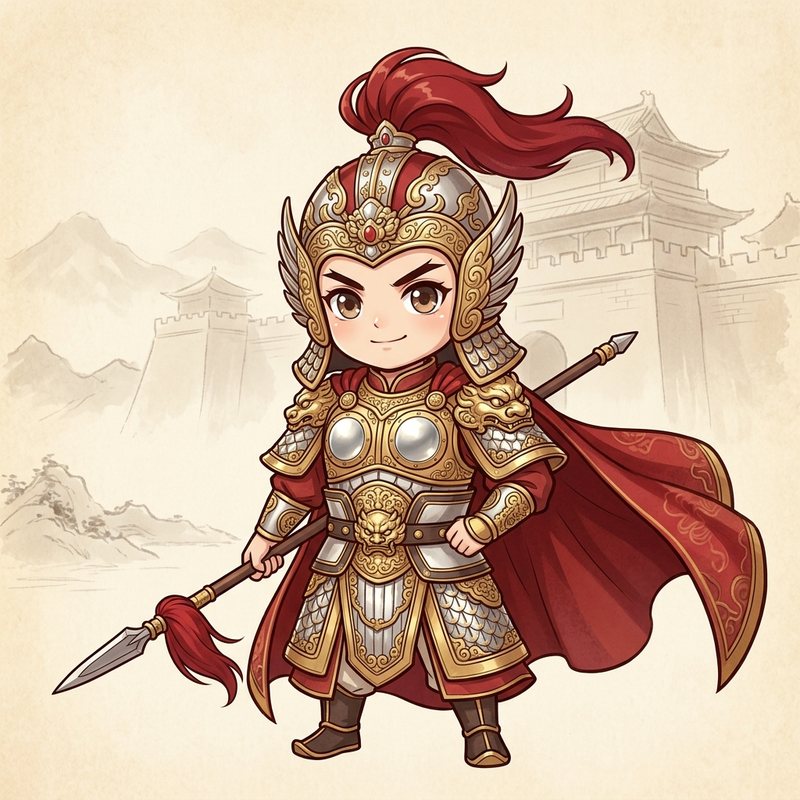
The Supreme Commander & Savior of the Tang Dynasty: crushed the An Lushan Rebellion, recaptured the dual capitals, and mastered both battlefield triumph and imperial survival.
Stops8
Traversed~2,390km
Audio Tour~12min
“身长七尺二寸,容貌伟秀,质性温裕。”
Standing over seven feet and two inches tall with a commanding presence, his nature was gentle and magnanimous.
Savior of the Tang DynastyTang Dynasty(697—781)谥忠武 · 世称郭汾阳/汾阳王Audio Journey · 8 Stops
The Supreme Commander who crushed the An Lushan Rebellion and mastered both battlefield triumph and imperial survival.
Savior of the Tang Dynasty· Scipio Africanus, savior of the Roman RepublicThe Unarmed Rider· A commander who wins through integrity, not forceMaster of Imperial Survival· The rare general who survives imperial glory
Unfolding the Historical Landscape…
印
Daily Wisdom & Resilience Oracle
The Resilient Optimist
“竹杖芒鞋轻胜马,谁怕?一蓑烟雨任平生。”
Holding a bamboo cane and wearing straw sandals, I stride faster than a horse. Who is afraid? A straw cloak in the mist and rain — I live my life with equanimity.
💡 In the 3rd year of exile in Huangzhou, caught in a sudden downpour, Su Shi embraced the storm with supreme resilience.
— Su Shi (Dongpo)(The Renaissance Foodie & Optimist)
Historical Footprints & Narration Archive
8 Stations
1
Zheng County, Huazhou
697 CE · Age 0
Modern Huazhou District, Weinan, Shaanxi
Born into a proud military clan in Huazhou, towering and ambitious from youth.
Standing over seven feet and two inches tall with a commanding presence, his nature was gentle and magnanimous.
Station Narration Script
In the martial clan home of Huazhou, young Guo Ziyi grew up during the reign of Empress Wu Zetian. Standing over seven feet tall with a commanding presence, he trained in horsemanship and military strategy while studying the classics, resolving to serve the nation.
Departure Transition Script
In his youth, Guo Ziyi traveled to Chang'an, passed the imperial martial examinations with highest honors, and entered the Tang military.
2
Chang'an
740 CE · Age 43
Imperial capital of Tang, modern Xi'an, Shaanxi
Passed the martial examinations with top honors, spending decades guarding the northwestern frontier.
Passing the imperial martial examination with highest honors, he was appointed Chief of Staff of the Left Guard, steadily rising to Military Commissioner of Shuofang.
Station Narration Script
Beneath the Vermilion Bird Gate of Chang'an, the young officer Guo Ziyi entered the Tang military with top honors in the martial examinations. Over decades in the golden Kaiyuan-Tianbao era, he commanded key northwestern garrisons, mastering logistics, mounted combat, and frontier diplomacy. He governed with discipline and calm, becoming the anchor of the Tang's northwest defense.
Departure Transition Script
In 755, the An Lushan Rebellion erupted, plunging the Tang into crisis and summoning Guo Ziyi to his historic role.
3
Lingwu
756 CE · Age 59
Modern Lingwu, Ningxia
With Chang'an fallen, rallied fifty thousand troops to Emperor Suzong at Lingwu and was appointed supreme commander.
“国家再造,卿之功也!”
Guójiā zàizào, qīng zhī gōng yě!
The rebirth of our imperial dynasty is entirely the fruit of your loyal devotion!
Station Narration Script
Before the imperial tent at Lingwu, the dust-covered Guo Ziyi arrived with fifty thousand elite Shuofang troops. With Chang'an fallen and the emperor in flight, the Tang teetered on collapse. Seeing Guo's disciplined banners, Emperor Suzong wept and proclaimed, 'The rebirth of our dynasty is entirely your doing!' He appointed Guo Supreme Commander of the imperial armies, opening the great counter-offensive.
Departure Transition Script
As Supreme Commander, Guo Ziyi led the imperial armies east through Jingxing Pass, joining forces with the legendary general Li Guangbi in Hebei.
4
Changshan & Boling, Hebei
756 CE · Age 59
Modern Zhengding & Dingzhou, Hebei
With Li Guangbi, won the great victory at Jiashan, crushing Shi Siming and severing the rebels' supply line.
“再造王室,勋高一代。”
Zài zào wángshì, xūn gāo yīdài.
He rebuilt the imperial house, his merit towering above a generation.
Station Narration Script
On the war-ravaged plains of Hebei, Guo Ziyi joined forces with the legendary general Li Guangbi. Facing the fierce rebel warlord Shi Siming, Guo laid a brilliant ambush at Jiashan, feigning retreat before unleashing his flanks to crush the rebel cavalry, slaying over forty thousand. The victory severed the rebellion's supply line, and seventeen commanderies returned to the Tang.
Departure Transition Script
In 757, Guo Ziyi commanded the great counter-offensive with allied Uyghur cavalry to recapture the dual capitals.
5
Luoyang
757 CE · Age 60
Eastern capital of the Tang Empire, modern Luoyang, Henan
Won the Battle of Xiangjisi, recaptured Chang'an and Luoyang, ending the An Lushan Rebellion.
“克复两京,威震华夷。”
Kè fù liǎng jīng, wēizhèn huáyí.
Recovering both imperial capitals, his military prestige shook the Chinese realm and foreign borders alike.
Station Narration Script
Before the Dingding Gate of Luoyang, the armored Guo Ziyi rode in triumph. At the Battle of Xiangjisi, he commanded the great counter-offensive with allied Uyghur cavalry, slaying sixty thousand and recapturing Chang'an; sweeping east, he liberated Luoyang. Both imperial capitals were restored, and the eight-year An Lushan Rebellion was finally crushed.
Departure Transition Script
After the disastrous Battle of Xiangzhou, the scheming eunuch Yu Chao'en slandered Guo Ziyi, who calmly surrendered his command.
6
Hezhong, Puzhou
760 CE · Age 63
Modern Yongji, Shanxi
After being slandered and stripped of command, reappointed to hold Hezhong, serving with strategic restraint.
Advancing without seeking fame, retreating without evading blame, dedicated solely to safeguarding the nation.
Station Narration Script
On the city wall of Hezhong, the aging Guo Ziyi surveyed the Yellow River. After the Battle of Xiangzhou collapsed, the scheming eunuch Yu Chao'en slandered him; Guo calmly surrendered his command without resentment. When rebellion flared again, he was reappointed Military Commissioner of Hedong. At Hezhong he fortified the defenses and held the strategic line, showing extraordinary political wisdom and generalship.
Departure Transition Script
In 765, the rebel general Pugu Huai'en lured a hundred-thousand-strong Tibetan-Uyghur invasion, summoning Guo Ziyi's legendary act of unarmed courage.
7
Binzhou
765 CE · Age 68
Modern Binzhou, Shaanxi
At nearly seventy, rode unarmed into the Uyghur camp, dissolving the hostile coalition through sheer integrity.
Removing his helmet to meet the enemy chieftain, he clasped hands in friendship and renewed their former alliance.
Station Narration Script
On the walls of Binzhou, the nearly seventy-year-old Guo Ziyi faced a hundred-thousand-strong Tibetan-Uyghur invasion. He made a breathtaking choice: removing his heavy armor and weapons, he rode alone with a few dozen attendants into the Uyghur camp. Removing his iron helmet, he cried, 'Do you not recognize Duke Guo?' The Uyghur chieftains, stunned to see him alive, dismounted and bowed. Guo clasped their hands, renewed their old alliance, and persuaded them to switch sides, jointly crushing the Tibetan invasion—the most magnificent legend of dissolving war through integrity.
Departure Transition Script
In his final years, Guo Ziyi was enfeoffed as Prince of Fenyang, dispelling imperial suspicion through transparent openness, and died in blessed longevity.
8
Chang'an
781 CE · Age 84
Imperial capital of Tang, modern Xi'an, Shaanxi
Served four emperors without arousing suspicion, died peacefully at eighty-five, deified as the 'Lu Star'.
“功盖天下而主不疑,位极人臣而众不疾,穷奢极欲而人不非之。”
Gōng gài tiānxià ér zhǔ bù yí, wèi jí rénchén ér zhòng bù jí, qióng shē jí yù ér rén bù fēi zhī.
His achievements overshadowed the empire yet the ruler never suspected him; he rose to the highest rank yet none envied him; he lived in extravagance yet no one condemned him.
Station Narration Script
In his mansion at Qinren Ward of Chang'an, the white-haired Prince of Fenyang sat in an open hall. Mastering the Daoist wisdom of 'retiring after success,' he kept his palace gates wide open to the public, dispelling imperial suspicion through transparent openness. His son Guo Nuan married Princess Shengping; after the famous 'drunken beating,' Guo Ziyi bound his son and led him to court to apologize, and Emperor Daizong laughed it off. With eight sons and seven sons-in-law in high office, Guo died peacefully at eighty-five, posthumously honored as 'Zhongwu,' and was later deified as the 'Lu Star' of fortune.
Departure Transition Script
Through a lifetime of loyalty and wisdom, Guo Ziyi crushed the An Lushan Rebellion, restored the dual capitals, and dissolved a hostile army through integrity—the eternal model of merit and survival, deified as the 'Lu Star' of fortune.
Key Historical Inquiries & Context
· 核心史实公案与速览
Guo Ziyi (697–781 CE), Prince of Fenyang, was the supreme Tang commander who crushed the An Lushan Rebellion and recaptured the twin capitals of Chang'an and Luoyang. He served four emperors with unblemished loyalty and wisdom.
Guo Ziyi (697–781 CE) was the supreme military commander of the Tang Dynasty who defeated the An Lushan rebels, restored Emperor Suzong and Emperor Daizong, and preserved the Tang empire from total collapse.
QHow did Guo Ziyi defeat the Uyghur-Tibetan allied invasion without fighting?
At Binzhou in 765 CE, 68-year-old Guo Ziyi removed his armor and rode unarmed into the Uyghur camp, reminding the khagan of their past alliance and persuading them to turn against the invading Tibetans.
The Complete Life Journey & Biography of Guo Ziyi (Tang General) (郭子仪)
Chronological travel & exile routes mapped to modern Chinese cities across Tang Dynasty China — featuring bilingual scholar audio, classical poetry recitations, and historical cross-paths.
Zheng County, Huazhou (华州郑县)
Age 0
Modern-day analog: Modern Huazhou District, Weinan, Shaanxi
Born into a proud military clan in Huazhou, towering and ambitious from youth.
In the martial clan home of Huazhou, young Guo Ziyi grew up during the reign of Empress Wu Zetian. Standing over seven feet tall with a commanding presence, he trained in horsemanship and military strategy while studying the classics, resolving to serve the nation.
In his youth, Guo Ziyi traveled to Chang'an, passed the imperial martial examinations with highest honors, and entered the Tang military.
“Standing over seven feet and two inches tall with a commanding presence, his nature was gentle and magnanimous.”
Modern-day analog: Imperial capital of Tang, modern Xi'an, Shaanxi
Passed the martial examinations with top honors, spending decades guarding the northwestern frontier.
Beneath the Vermilion Bird Gate of Chang'an, the young officer Guo Ziyi entered the Tang military with top honors in the martial examinations. Over decades in the golden Kaiyuan-Tianbao era, he commanded key northwestern garrisons, mastering logistics, mounted combat, and frontier diplomacy. He governed with discipline and calm, becoming the anchor of the Tang's northwest defense.
In 755, the An Lushan Rebellion erupted, plunging the Tang into crisis and summoning Guo Ziyi to his historic role.
“Passing the imperial martial examination with highest honors, he was appointed Chief of Staff of the Left Guard, steadily rising to Military Commissioner of Shuofang.”
With Chang'an fallen, rallied fifty thousand troops to Emperor Suzong at Lingwu and was appointed supreme commander.
Before the imperial tent at Lingwu, the dust-covered Guo Ziyi arrived with fifty thousand elite Shuofang troops. With Chang'an fallen and the emperor in flight, the Tang teetered on collapse. Seeing Guo's disciplined banners, Emperor Suzong wept and proclaimed, 'The rebirth of our dynasty is entirely your doing!' He appointed Guo Supreme Commander of the imperial armies, opening the great counter-offensive.
As Supreme Commander, Guo Ziyi led the imperial armies east through Jingxing Pass, joining forces with the legendary general Li Guangbi in Hebei.
“The rebirth of our imperial dynasty is entirely the fruit of your loyal devotion!”
国家再造,卿之功也! (Guójiā zàizào, qīng zhī gōng yě!)
Changshan & Boling, Hebei (河北常山、博陵)
Age 59
Modern-day analog: Modern Zhengding & Dingzhou, Hebei
With Li Guangbi, won the great victory at Jiashan, crushing Shi Siming and severing the rebels' supply line.
On the war-ravaged plains of Hebei, Guo Ziyi joined forces with the legendary general Li Guangbi. Facing the fierce rebel warlord Shi Siming, Guo laid a brilliant ambush at Jiashan, feigning retreat before unleashing his flanks to crush the rebel cavalry, slaying over forty thousand. The victory severed the rebellion's supply line, and seventeen commanderies returned to the Tang.
In 757, Guo Ziyi commanded the great counter-offensive with allied Uyghur cavalry to recapture the dual capitals.
“He rebuilt the imperial house, his merit towering above a generation.”
再造王室,勋高一代。 (Zài zào wángshì, xūn gāo yīdài.)
Luoyang (洛阳)
Age 60
Modern-day analog: Eastern capital of the Tang Empire, modern Luoyang, Henan
Won the Battle of Xiangjisi, recaptured Chang'an and Luoyang, ending the An Lushan Rebellion.
Before the Dingding Gate of Luoyang, the armored Guo Ziyi rode in triumph. At the Battle of Xiangjisi, he commanded the great counter-offensive with allied Uyghur cavalry, slaying sixty thousand and recapturing Chang'an; sweeping east, he liberated Luoyang. Both imperial capitals were restored, and the eight-year An Lushan Rebellion was finally crushed.
After the disastrous Battle of Xiangzhou, the scheming eunuch Yu Chao'en slandered Guo Ziyi, who calmly surrendered his command.
“Recovering both imperial capitals, his military prestige shook the Chinese realm and foreign borders alike.”
克复两京,威震华夷。 (Kè fù liǎng jīng, wēizhèn huáyí.)
Hezhong, Puzhou (河中蒲州)
Age 63
Modern-day analog: Modern Yongji, Shanxi
After being slandered and stripped of command, reappointed to hold Hezhong, serving with strategic restraint.
On the city wall of Hezhong, the aging Guo Ziyi surveyed the Yellow River. After the Battle of Xiangzhou collapsed, the scheming eunuch Yu Chao'en slandered him; Guo calmly surrendered his command without resentment. When rebellion flared again, he was reappointed Military Commissioner of Hedong. At Hezhong he fortified the defenses and held the strategic line, showing extraordinary political wisdom and generalship.
In 765, the rebel general Pugu Huai'en lured a hundred-thousand-strong Tibetan-Uyghur invasion, summoning Guo Ziyi's legendary act of unarmed courage.
“Advancing without seeking fame, retreating without evading blame, dedicated solely to safeguarding the nation.”
At nearly seventy, rode unarmed into the Uyghur camp, dissolving the hostile coalition through sheer integrity.
On the walls of Binzhou, the nearly seventy-year-old Guo Ziyi faced a hundred-thousand-strong Tibetan-Uyghur invasion. He made a breathtaking choice: removing his heavy armor and weapons, he rode alone with a few dozen attendants into the Uyghur camp. Removing his iron helmet, he cried, 'Do you not recognize Duke Guo?' The Uyghur chieftains, stunned to see him alive, dismounted and bowed. Guo clasped their hands, renewed their old alliance, and persuaded them to switch sides, jointly crushing the Tibetan invasion—the most magnificent legend of dissolving war through integrity.
In his final years, Guo Ziyi was enfeoffed as Prince of Fenyang, dispelling imperial suspicion through transparent openness, and died in blessed longevity.
“Removing his helmet to meet the enemy chieftain, he clasped hands in friendship and renewed their former alliance.”
Modern-day analog: Imperial capital of Tang, modern Xi'an, Shaanxi
Served four emperors without arousing suspicion, died peacefully at eighty-five, deified as the 'Lu Star'.
In his mansion at Qinren Ward of Chang'an, the white-haired Prince of Fenyang sat in an open hall. Mastering the Daoist wisdom of 'retiring after success,' he kept his palace gates wide open to the public, dispelling imperial suspicion through transparent openness. His son Guo Nuan married Princess Shengping; after the famous 'drunken beating,' Guo Ziyi bound his son and led him to court to apologize, and Emperor Daizong laughed it off. With eight sons and seven sons-in-law in high office, Guo died peacefully at eighty-five, posthumously honored as 'Zhongwu,' and was later deified as the 'Lu Star' of fortune.
Through a lifetime of loyalty and wisdom, Guo Ziyi crushed the An Lushan Rebellion, restored the dual capitals, and dissolved a hostile army through integrity—the eternal model of merit and survival, deified as the 'Lu Star' of fortune.
“His achievements overshadowed the empire yet the ruler never suspected him; he rose to the highest rank yet none envied him; he lived in extravagance yet no one condemned him.”
功盖天下而主不疑,位极人臣而众不疾,穷奢极欲而人不非之。 (Gōng gài tiānxià ér zhǔ bù yí, wèi jí rénchén ér zhòng bù jí, qióng shē jí yù ér rén bù fēi zhī.)