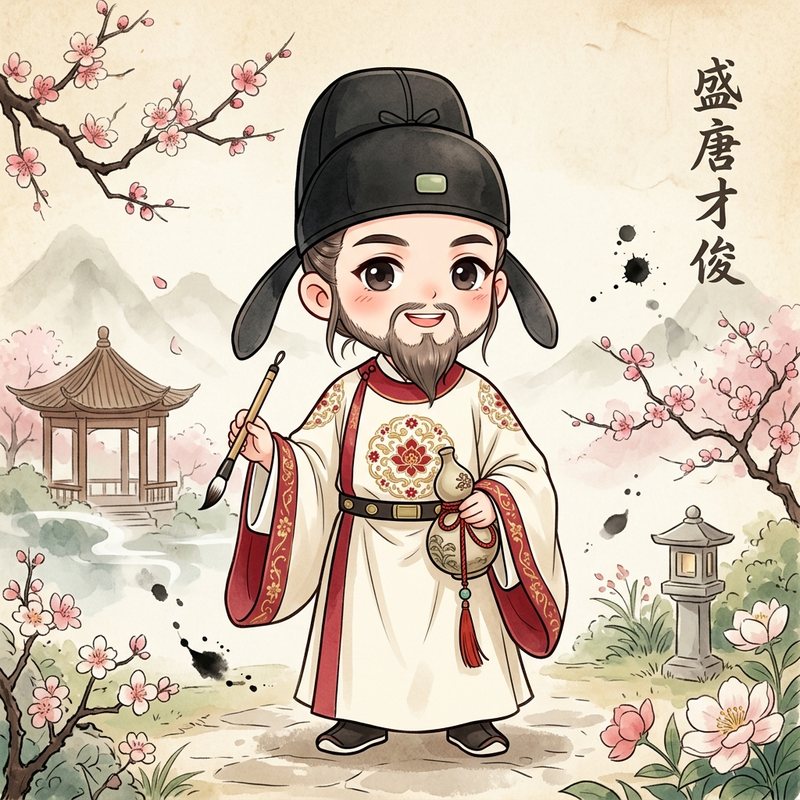
Wang Wei
Tang Dynasty(701–761)Age 0 · Puzhou Birthplace“The Poet Buddha: master of Zen nature poetry and founding father of Southern School ink painting.”
The Complete Life Journey & Biography of Wang Wei (王维)
Chronological travel & exile routes mapped to modern Chinese cities across Tang Dynasty China — featuring bilingual scholar audio, classical poetry recitations, and historical cross-paths.
Chang'an Imperial Examination Triumph (长安及第)
Age 20721 CEModern-day analog: Tang imperial capital and metropolitan examination center, modern Xi'an, Shaanxi
Captivating imperial salons with his lute masterpiece 'The Feather Robe', he passed the imperial examinations at twenty-one to direct royal music.
In the imperial capital of Chang'an, blooming with unprecedented wealth and culture, young Wang Wei arrived with his five-stringed lute. At royal salons, his performance of 'The Feather Robe' held nobles spellbound with ethereal acoustic purity. Passing the prestigious Jinshi examinations at twenty-one, he was awarded directorship of imperial music—a young genius shining at the very zenith of the High Tang.
“Who pities the Yue maiden with a face pure as jade, washing silk in poverty by the riverbank alone?”
谁怜越女颜如玉,贫贱江头自浣纱。(Shuí lián Yuè nǚ yán rú yù, pín jiàn jiāng tóu zì huàn shā.)Jizhou Demotion (济州初贬)
Age 20721 CEModern-day analog: Provincial canal crossroad and imperial grain granary center, modern Jining, Shandong
Demoted to grain supply officer in Jizhou over an unauthorized court lion dance, enduring his first plunge into bureaucratic obscurity.
From the grand palaces of Chang'an to the dusty grain silos of Jizhou in Shandong, twenty-year-old Wang Wei confronted the harsh unpredictability of imperial power. Yet he did not wallow in despair. Diligently balancing ledgers and inspecting public granaries, he walked among reeds along the Ji River, shedding youthful vanity and cultivating a quiet, enduring fortitude.
“A minor official easily incurs blame, cast away south into the shadows of the Ji River.”
微官易得罪,谪去济川阴。(Wēi guān yì dé zuì, zhé qù Jì chuān yīn.)Qishang Hermitage (淇上隐居)
Age 25726 CEModern-day analog: Scenic river basin known for bamboo groves and Taoist retreats, modern Hebi, Henan
Resigning to till fields and meditate along the Qi River, following Tao Yuanming to establish his lifelong pastoral aesthetic.
Along the Qi River in Henan, dense bamboo groves swayed beside pristine waters. Here the young poet tasted the unburdened life of a hermit-farmer. Hoeing wild weeds at dawn, steering skiffs at sunset, and reading Buddhist sutras in empty halls by night, he found harmony with the voice of the wind. This pastoral interlude nurtured the gentle, lucid aesthetics that would crown him master of landscape verse.
“Living in seclusion I follow the ways of Tao Qian; in the tranquil night I sit meditating in an empty hall.”
屏居冠栗里,清夜坐虚堂。(Píng jū guān Lì lǐ, qīng yè zuò xū táng.)Chang'an Court Return (长安献纳)
Age 33734 CEModern-day analog: Tang imperial chancery and Daming Palace counseling chambers, modern Xi'an, Shaanxi
Promoted to Right Reminder by Chancellor Zhang Jiuling, offering courageous court counsel during Kaiyuan's golden twilight.
Returning to the halls of Daming Palace, thirty-something Wang Wei earned the deep trust of Chancellor Zhang Jiuling. As Right Reminder, he spoke candidly on public welfare, seeking to reform governance. Yet as unscrupulous rivals marginalized loyal statesmen, Wang Wei refused compromise, guarding his moral center through inner meditation.
“Humbly kneeling I present myself: may I serve faithfully beneath your banner?”
贱子跪自陈,可为帐下不?(Jiàn zǐ guì zì chén, kě wéi zhàng xià fǒu?)Liangzhou Frontier Expedition (凉州塞上)
Age 36737 CEModern-day analog: Hexi Corridor military garrison and Silk Road gateway, modern Wuwei, Gansu
Serving as military inspector in the Hexi Corridor, capturing the desert's straight smoke and round setting sun in immortal verse.
With Qilian snow peaks looming above arid plains, Wang Wei rode through the whistling winds of the Hexi Corridor as imperial commissioner. A solitary beacon smoke rose arrow-straight into the heavens; an immense crimson sun dipped gently beside the Yellow River. This minimalist geometric majesty permanently redefined Chinese landscape aesthetics and expanded his spirit to the horizon itself.
“In the boundless desert a lone smoke rises straight; along the endless river the setting sun hangs round.”
大漠孤烟直,长河落日圆。(Dà mò gū yān zhí, cháng hé luò rì yuán.)Zhongnan Mountain Hermitage (终南幽居)
Age 40741 CEModern-day analog: Legendary mountain sanctuary for Daoist and Buddhist hermits, southern Xi'an, Shaanxi
Pioneering the 'half-official, half-hermit' lifestyle, discovering boundless freedom where outward waters end and clouds rise.
Beneath the soaring crags of the Zhongnan range, middle-aged Wang Wei discovered perfect equilibrium. On days of leave, he wandered solitary trails with no agenda. Reaching the rocky headwaters where the stream vanished into mist, he simply sat on the stones and watched clouds blossom above the peaks—an immortal testament to inner composure beyond worldly ambition.
“I stroll to where the water ends, and sit to watch the rising clouds.”
行到水穷处,坐看云起时。(Xíng dào shuǐ qióng chù, zuò kàn yún qǐ shí.)Wangchuan Villa Retreat (辋川胜境)
Age 44744 CEModern-day analog: Fabled poet-painter estate and Zen nature sanctuary in Lantian Valley, modern Xi'an, Shaanxi
Crafting the twenty scenic sights of Wangchuan with companion Pei Di, fusing poetry, painting, and Chan into timeless serenity.
Wangchuan Stream wound like a jade ribbon through the emerald defiles of Lantian. Here Wang Wei established Chinese literature's purest artistic sanctuary. Plucking the zither inside quiet bamboo thickets, only the autumn moon kept him company; in empty ravines, rays of dying sunlight illuminated patches of green moss. In duet with his friend Pei Di, he distilled life into pure ink and verse, attaining the pinnacle of the Poet Buddha.
“Empty mountain, no one seen, yet the echo of voices drifts on the air. Returning sunlight enters the deep grove, shining once more upon green moss.”
空山不见人,但闻人语响。返景入深林,复照青苔上。(Kōng shān bú jiàn rén, dàn wén rén yǔ xiǎng. Fǎn jǐng rù shēn lín, fù zhào qīng tái shàng.)Chang'an Shangshu Youcheng & Final Transcendence (长安右丞)
Age 60761 CEModern-day analog: Tang imperial chancery and high state council, modern Xi'an, Shaanxi
Enduring captivity with his covert loyalist poem, pardoned and elevated to Vice Prime Minister before departing in tranquil meditation.
Surviving the tragic fall of the twin capitals and captive interrogation, Wang Wei endured through moral integrity and Buddhist equanimity. Elevated to Vice Prime Minister, he lived without pride, maintaining simple vegetarian habits and daily meditation. In 761 CE, sensing his journey's end, the sixty-one-year-old master calmly brushed farewell letters to his brother and lifelong friends, laid down his ink-brush, and passed into eternity with complete serenity.
“From myriad households sorrow rises like wild smoke; when will the hundred officials attend the Son of Heaven again? In empty courtyards autumn locust leaves cascade, while pipes and strings play on beside Ningbi Pond.”
万户伤心生野烟,百官何日再朝天。秋槐叶落空宫里,凝碧池头奏管弦。(Wàn hù shāng xīn shēng yě yān, bǎi guān hé rì zài cháo tiān. Qiū huái yè luò kōng gōng lǐ, Níng bì chí tóu zòu guǎn xián.)
Literati Knowledge Vault · 先贤知识宝库
In-Depth Essays & Philosophical Inquiries on Wang Wei
Deep dives, myth-busting, and modern psychological lessons from Wang Wei's life and philosophy.
暂无已发布的深度专栏文章。
Historical Nexus & Intersecting Journeys
与 王维 (Wang Wei) 时空交汇、思想交锋或命运相连的华夏先贤网络
Historical Nexus & Intersecting Journeys
与 王维 时空交汇、思想交锋或命运相连的华夏先贤网络

Li Bai
李白
Contemporaries in High Tang Changan representing serene Buddhist meditation versus wild Daoist flight.
盛唐诗坛双星,王维诗中有画,李白豪迈如仙,朝廷与草莽交映成趣。
Du Fu
杜甫
Du Fu praised Wang's flawless lines; both endured the trauma of rebellion that shattered their generation.
杜甫作诗赞王维'最传秀句寰区满',同经天宝乱局,诗风一入空灵一入沉郁。
Key Historical Inquiries & Context
关于 王维 (Wang Wei) 的核心史实考证、公案辨析与中英直答
Who was Wang Wei (王维)?
Wang Wei (701–761), styled Mojie, was an illustrious Tang Dynasty poet, painter, musician, and statesman from Hedong (modern Yongji, Shanxi), hailed across East Asian history as the 'Poet Buddha' (Shi Fo). A celebrated prodigy who passed the imperial examinations at twenty-one and held posts from court musician to Vice Prime Minister (Shangshu Youcheng), he harmonized deep Chan Buddhist meditation with landscape art. At his beloved Wangchuan Villa in Lantian, he created the twenty-poem Wangchuan Collection and pioneering ink-wash scrolls, celebrated by Su Shi as possessing 'painting in his poetry and poetry in his painting.'
What was Wang Wei's primary cultural and historical legacy?
Wang Wei is celebrated across world history as a pioneer of The Impressionist of Chinese Poetry, The Hermit of Wangchuan Valley, The Poet Buddha of Serenity, leaving enduring philosophical insights, literature, and art.
Where does Wang Wei's historical life journey map lead?
This interactive GIS map retraces 9 chronological stops across Tang Dynasty China, originating from Puzhou Birthplace and spanning through Chang'an Shangshu Youcheng & Final Transcendence.