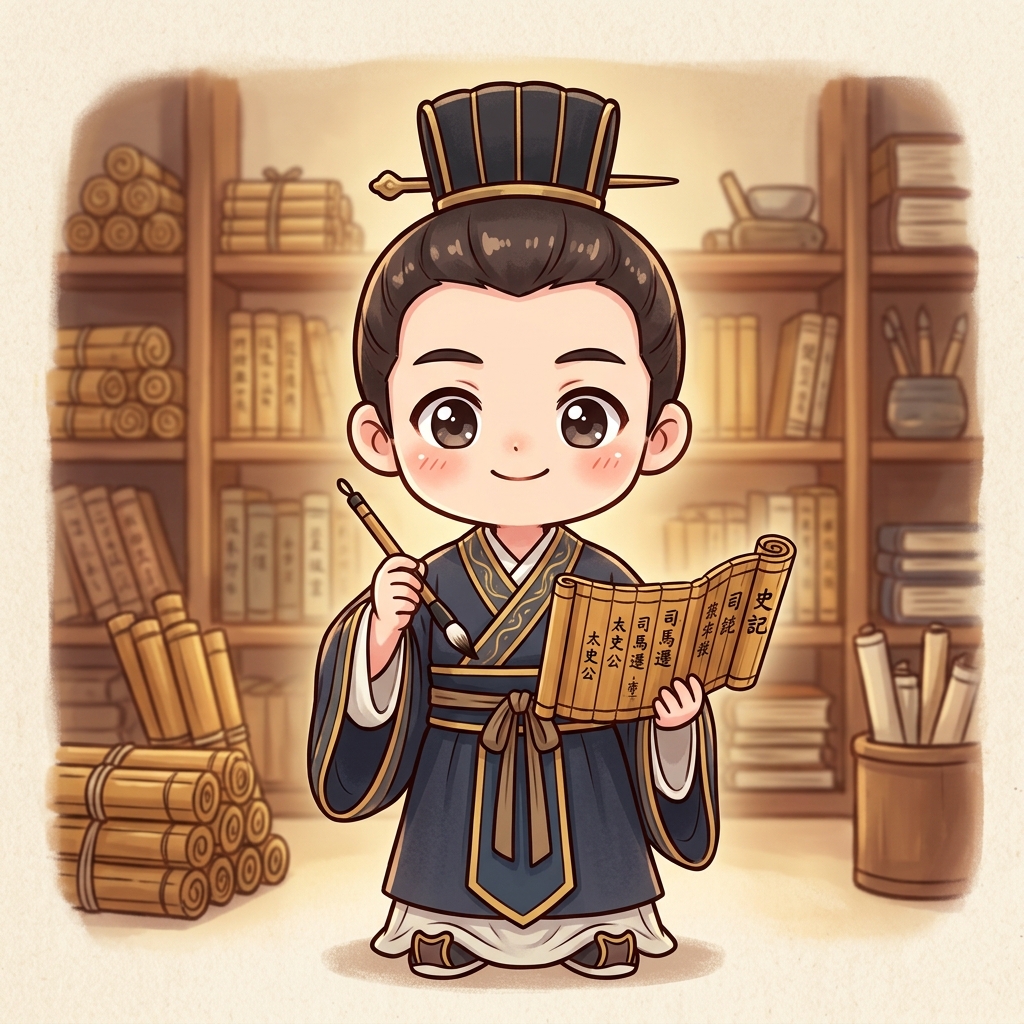
Sima Qian (司马迁) — Father of Chinese Historiography & Author of Records of the Grand Historian
Dynasty: Western Han Dynasty
To examine the intersection of Heaven and Man, to comprehend the changes from past to present, and to establish a philosophy of my own.
Life Footprint & Journey Nodes
Longmen (Hancheng, Birthplace) (龙门夏阳(生于黄河之滨)) - Age 1
Hancheng, Weinan, Shaanxi Province
Born where the Yellow River surges through the Longmen Gorges, he farmed and grazed livestock while memorizing ancient classical codices at age ten.
Growing up near the dramatic Longmen Gorge where legendary Yu the Great channeled the ancient floods, young Sima Qian was immersed in classical lore. His father Sima Tan, the Imperial Grand Astrologer, trained him in astronomy and chronologies, while Confucian masters Dong Zhongshu and Kong Anguo tutored him in ancient texts.
I, Qian, was born at Longmen, farming and herding south of the mountains by the river. At ten years of age, I memorized the ancient classics.
迁生龙门,耕牧河山之阳。年十岁,则诵古文。 (Qiān shēng Lóng mén, gēng mù hé shān zhī yáng.)Grand Tour Across Ancient China (江淮湖海(二十漫游天下,考问古迹)) - Age 20
Hunan, Zhejiang, Jiangsu, and Shandong
At twenty he set out across China: climbing Mount Lu, visiting Great Yu's cave at Kuaiji, weeping by the Miluo River for Qu Yuan, and interviewing elders.
He sailed down the Yangtze, searched out Yu the Great's burial tomb at Shaoxing, wept along the Miluo River where poet Qu Yuan drowned, and visited Confucius's hometown in Qufu. In Pei and Huai'an, he interviewed elderly villagers who remembered Liu Bang and Han Xin in their youth, infusing his future chronicles with pulsating human reality.
At twenty I traveled south along the Yangtze and Huai rivers, ascended Mount Kuaiji to explore Yu's cave, gazed upon Mount Jiuyi, and floated on the Yuan and Xiang; I crossed the Wen and Si rivers northward to study in the ancient capitals of Qi and Lu.
二十而南游江、淮,上会稽,探禹穴,窥九嶷,浮于沅、湘;北涉汶、泗,讲业齐、鲁之都。 (Èr shí ér nán yóu Jiāng, Huái...)Luoyang & Chang'an (Inheriting the Oath) (洛阳与长安(太史公托孤,创太初历)) - Age 35
Luoyang, Henan & Weiyang District, Xi'an, Shaanxi
As Emperor Wu celebrated the Mount Tai rituals, his dying father grasped his hand in tears, beseeching him: 'When I die, you shall be Grand Historian; forget not what I dreamed to write!'
Barred by illness from attending Emperor Wu's sacred Feng Shan rituals, Sima Tan was dying in Luoyang. Weeping, he said: 'Over four hundred years have elapsed since Confucius died. Now the world is unified under Han, yet historical chronicles languish neglected! When you succeed me as Grand Historian, complete the work!' Kneeling with tears, Sima Qian replied: 'Though unworthy, I shall recount all that our ancestors preserved; I dare not leave it incomplete!'
Though I lack brilliance, I pray to set forth in full all the ancient memories that our ancestors arranged, daring not let a single record be lost.
小子不敏,请悉论先人所次旧闻,弗敢阙。 (Xiǎo zǐ bù mǐn, qǐng xī lùn xiān rén suǒ cì jiù wén, fú gǎn quē.)Chang'an Palace Prison (Enduring Castration) (长安蚕室(李陵之祸,直言受刑)) - Age 46
Weiyang Palace site, Xi'an, Shaanxi Province
When General Li Ling surrendered after his 5,000 foot-soldiers were enveloped by 80,000 Xiongnu cavalry, Sima Qian spoke truth to power, suffering castration.
Surrounded by 80,000 steppe horsemen, Li Ling had fought until his men ran out of arrows and food. Courtiers cowardly demanded his execution. Sima Qian alone stood forth to testify to Li Ling's valor. Enraged, Emperor Wu condemned him to death. Too poor to buy pardon and abandoned by friends, Sima Qian chose the humiliating mutilation of castration instead of honorable suicide—solely so his unfinished manuscript might survive.
No misfortune is more agonizing than grief of heart; no conduct more shameful than disgracing one's ancestors; and no degradation greater than castration.
祸莫憯于欲利,悲莫痛于伤心,行莫丑于辱先,诟莫大于宫刑。 (Huò mò cǎn yú yù lì...)Chang'an (Writing the Monument of Human History) (长安史馆(发愤著书,成一家之言)) - Age 59
Chang'an historical city, Xi'an, Shaanxi Province
Emerging from prison, he channeled unendurable grief into supreme art, producing the 520,000-word 'Records of the Grand Historian' spanning 3,000 years of civilization.
Appointed palace secretary after his ordeal, memories of humiliation caused cold sweat to drench his robes every day. Yet drawing inspiration from King Wen writing the I Ching in captivity and Qu Yuan writing the Li Sao in exile, he poured his soul into bamboo slips. He revolutionized world history by creating biographies for not only emperors, but also philosophers, merchants, rebels, and wandering assassins, illuminating the human condition.
A person truly dies but once: it may be weightier than Mount Tai, or lighter than a swan feather—all depends on how one employs it. I sought to examine the intersection of Heaven and Man, to comprehend the changes from past to present, and to establish a philosophy of my own.
人固有一死,或重于泰山,或轻于鸿毛,用之所趋异也。亦欲以究天人之际,通古今之变,成一家之言。 (Rén gù yǒu yī sǐ, huò zhòng yú Tàishān, huò qīng yú hóngmáo...)
In-Depth Essays & Philosophical Inquiries on Sima Qian
Browse All Classical Wisdom Essays in Directory
- Sima Qian vs. Herodotus: How the Fathers of History Shaped the East and West
Sima Qian vs Herodotus: Compare the Fathers of History in ancient China and Greece—their methods, tragedies, worldviews, and enduring civilizational legacies.