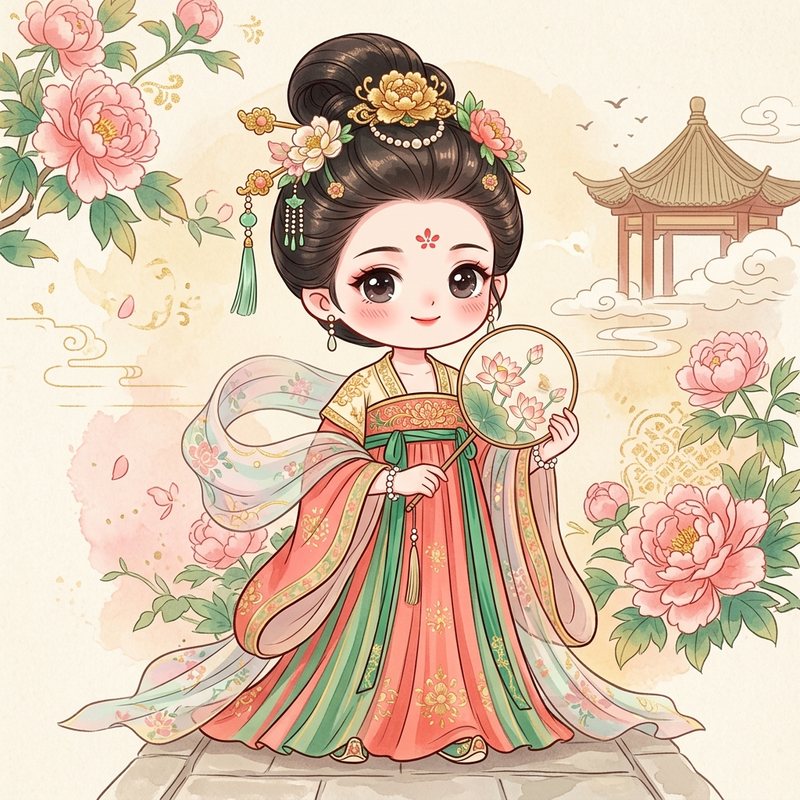
Shangguan Wan'er
Tang Dynasty(664–710)Age 0 · Shanzhou Birthplace“From palace slave to imperial chancellor: drafting state decrees and judging imperial poetry with brilliant statesmanship.”
The Complete Life Journey & Biography of Shangguan Wan'er (Poetess) (上官婉儿)
Chronological travel & exile routes mapped to modern Chinese cities across Tang Dynasty China — featuring bilingual scholar audio, classical poetry recitations, and historical cross-paths.
Ye Ting Palace Academy (长安掖庭)
Age 13677 CEModern-day analog: Imperial palace slave quarters & inner court academy in historic Chang'an, modern Xi'an
After fourteen years of classical study in slave quarters, she aced Empress Wu's imperial test and won instant emancipation.
The iron gates of Chang'an's Ye Ting could not contain her astonishing brilliance. Summoned before Empress Wu in the great Daming Palace, fourteen-year-old Wan'er dipped her brush and composed with effortless grace. Her prose captivated the ruler, earning instant pardon and a post as confidential royal scribe. With words as her weapon, the former slave stepped directly into the imperial light.
“Dense foliage sprouts forth from clever shears; fresh blossoms unfurl as the scissors dance.”
密叶因裁吐,新花逐翦舒。(Mì yè yīn cái tǔ, xīn huā zhú jiǎn shū.)Divine Capital Luoyang (神都洛阳)
Age 20684 CEModern-day analog: Mingtang ceremonial center & Eastern Capital of the Tang-Zhou transition, modern Luoyang
Accompanying the sovereign to Luoyang, she drafted grand ceremonial texts for the Mingtang and coronation rituals.
In the Divine Capital of Luoyang, the soaring towers of the Mingtang pierced the clouds, witnessing an unprecedented era. Standing beside Empress Wu's imperial dais, twenty-year-old Wan'er drafted the grand edicts that reverberated across Asia. She was far more than a literary scribe—she was the voice of the imperial will, shaping the majesty of a new dynasty.
“Passing years welcome the dawn of the new; this present year succeeds the seasons that came before.”
去岁迎新岁,今年后去年。(Qù suì yíng xīn suì, jīn nián hòu qù nián.)Ziwei Palace Inner Cabinet (洛阳掌制)
Age 32696 CEModern-day analog: Inner imperial secretariat of the Tang-Zhou palace city, modern Luoyang
Entrusted with reviewing all hundred-ministry petitions and drafting imperial policy as de facto chancellor.
In the depths of the Ziwei Palace in Luoyang, Shangguan Wan'er held the reins of imperial administration. Stacks of memorials from every corner of China met her sharp gaze and decisive red-ink brushes. She balanced factional rivalries while safeguarding dynastic stability. Without the formal title, she exercised full ministerial power, creating a landmark of female governance in Chinese history.
“Consort Zhaorong dominated court brilliance across two reigns; amid ten thousand state affairs a day, she responded with the speed of an echo whenever consulted.”
昭容两朝专美,一日万机,顾问不遗,应接如响。(Zhāoróng liǎng cháo zhuān měi, yī rì wàn jī, gùwèn bù yí, yìng jiē rú xiǎng.)Imperial Academy Compilation (洛阳修文)
Age 34698 CEModern-day analog: Imperial library pavilion and scholarly compilation hall in Luoyang
Led forty eminent scholars to compile the 1,300-volume Sanjiao Zhuying, establishing literary leadership.
Inside the Xiouwen Pavilion in Luoyang, the scent of ink drifted among thousands of parchment scrolls. Forty of the realm's most learned Confucian masters sat together, led by Shangguan Wan'er. Over 1,300 volumes of the Sanjiao Zhuying united the philosophical heritage of China. Her scholarly rigor earned the deep reverence of the intellectual elite, setting the cultural foundation for the High Tang.
“Literature channels universal truths; an assembly of eminent talents competes in brilliant splendor.”
文以贯道,群英竞秀。(Wén yǐ guàn dào, qún yīng jìng xiù.)Daming Palace Zhaowenguan (长安昭容)
Age 41705 CEModern-day analog: Imperial academy hall & secretariat of Daming Palace, historic Chang'an, modern Xi'an
Elevated to Consort Zhaorong, she urged the expansion of the academy to recruit scholars across the empire.
The sudden political shift in Chang'an could not shake Wan'er's calm authority. Restored Emperor Zhongzong elevated her to Consort Zhaorong, keeping state edicts firmly in her hands. Yet Wan'er looked far beyond the palace walls. She championed civil education, opening academy doors to scholars of humble birth. Beneath the eaves of Daming Palace, her enlightened policies set the stage for the golden age of Tang literature.
“Though the Han praised Ban Zhao and Jin celebrated Zuo Fen, their literary paths were similar, yet her civil governance and counsel far surpassed them all.”
虽汉称班媛,晋誉左嫔,文章之道不殊,辅佐之功则异。(Suī Hàn chēng Bānyuán, Jìn yù Zuǒpín, wénzhāng zhī dào bù shū, fǔzuǒ zhī gōng zé yì.)Kunming Lake Poetry Pavilion (昆明池彩楼)
Age 45709 CEModern-day analog: Expansive imperial lake park & royal water tournament grounds southwest of Chang'an
Presided over the grand tournament at Kunming Lake, tossing rejected drafts and codifying High Tang poetic meter.
Across the sparkling waters of Kunming Lake, imperial courtiers held their breath before the grand silk pavilion. Forty-five-year-old Shangguan Wan'er sat by the railing, judging the kingdom's finest poetic minds. Rejected scrolls fluttered down into the breeze like snow, while her chosen verses defined the meter and grandeur of High Tang poetry. That pavilion stood as an eternal monument to a woman's intellectual supremacy over a literary empire.
“Looking afar, lightning leaps as dragons turn to steeds; looking back, frost glitters as wild geese form bowstrings across the sky.”
遥看电跃龙为马,回瞩霜凌雁作弦。(Yáo kàn diàn yuè lóng wéi mǎ, huí zhǔ shuāng líng yàn zuò xián.)Imperial Palace & Hongdu Tomb (长安终局)
Age 46710 CEModern-day analog: Imperial palace courtyards of Chang'an and commemorative Hongdu tomb in Xianyang
Met nocturnal coup forces holding candles before execution; her 2013 excavated tomb epitaph vindicated her loyalty.
On a bloodstained night in Chang'an, Shangguan Wan'er walked toward the coup forces holding a single candle. Facing drawn swords, she held up the imperial testament she had drafted to save the dynasty. Though political brutality cut her down beneath the banners, history would not forget her. In 2013, her stone epitaph was unearthed from Xianyang: 'For ten thousand years, pepper blossoms will sing her praises,' vindicating China's extraordinary female chancellor for eternity.
“The waters of the Xiao and Xiang run dry; Mount Wanwei collapses. The pearl sinks and amber shatters, laying her life to eternal rest. For a thousand years, for ten thousand years, the pepper blossoms will sing her praises.”
潇湘水断,宛委山倾。珠沉珀碎,息偃平生。千年万岁,椒花颂声。(Xiāoxiāng shuǐ duàn, Wǎnwěi shān qīng. Zhū chén pò suì, xī yǎn píngshēng. Qiānnián wànsuì, jiāohuā sòngshēng.)
Literati Knowledge Vault · 先贤知识宝库
In-Depth Essays & Philosophical Inquiries on Shangguan Wan'er
Deep dives, myth-busting, and modern psychological lessons from Shangguan Wan'er's life and philosophy.
暂无已发布的深度专栏文章。
Historical Nexus & Intersecting Journeys
与 上官婉儿 (Shangguan Wan'er) 时空交汇、思想交锋或命运相连的华夏先贤网络
Historical Nexus & Intersecting Journeys
与 上官婉儿 时空交汇、思想交锋或命运相连的华夏先贤网络
Key Historical Inquiries & Context
关于 上官婉儿 (Shangguan Wan'er) 的核心史实考证、公案辨析与中英直答
Who was Shangguan Wan'er (上官婉儿)?
Shangguan Wan'er (664–710) was a prominent Tang Dynasty statesman, imperial secretary, and poet from Shanzhou, Henan. The granddaughter of Chancellor Shangguan Yi, she was enslaved in the palace harem as an infant following her family's fall. Raised under adversity, she mastered classical literature and statecraft, winning emancipation at fourteen when Empress Wu Zetian tested her literary genius. Entrusted with drafting state decrees and reviewing petitions from 696 onward, she functioned as de facto prime minister. Under Emperor Zhongzong, she was made imperial consort Zhaorong, expanded the imperial academy, and served as supreme judge in grand poetry contests, shaping High Tang verse. Killed during the 710 palace coup, she was honored with an excavated 982-character epitaph and a 20-volume imperial collection.
What was Shangguan Wan'er's primary cultural and historical legacy?
Shangguan Wan'er is celebrated across world history as a pioneer of The Lady Chancellor & Imperial Scribe, Supreme Arbiter of Imperial Poetry, Unbroken Mind in the Palace Maze, leaving enduring philosophical insights, literature, and art.
Where does Shangguan Wan'er's historical life journey map lead?
This interactive GIS map retraces 8 chronological stops across Tang Dynasty China, originating from Shanzhou Birthplace and spanning through Imperial Palace & Hongdu Tomb.