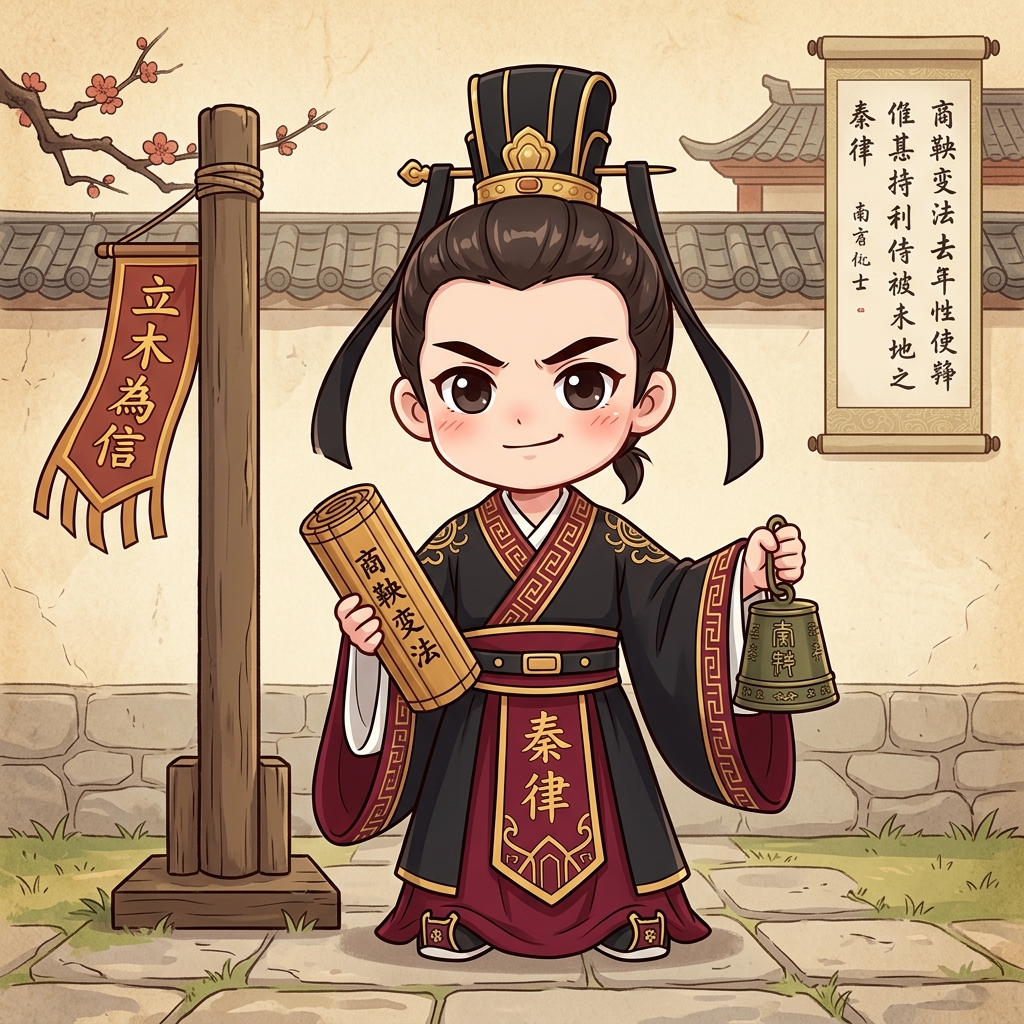
Shang Yang (Lord Shang) (商鞅) — The Legalist Architect of Qin's Imperial Dominance
Dynasty: Warring States Period
To govern the realm, one need not emulate antiquity; to benefit the state, one must forge new laws.
Life Footprint & Journey Nodes
State of Wey & Wei (Legalist Tutelage) (卫国与魏国(研读刑名,求真思变)) - Age 1
Puyang, Henan & Xia County, Yuncheng, Shanxi
Born into the nobility of the small State of Wey, he immersed himself in legal codices and studied under Chancellor Gongshu Zuo in powerful Wei.
Young Shang Yang studied the pioneering Legalist codes of Li Kui and Wu Qi. On his deathbed, Wei Chancellor Gongshu Zuo advised King Hui of Wei: 'Either appoint this young man prime minister, or execute him so he may never serve another state.' The King dismissed the advice, leaving Shang Yang free to seek a sovereign worthy of his grand designs.
Since the King cannot recognize my worth to employ me, how could he possess the wisdom to kill me?
彼王不能用,安能杀我! (Bǐ wáng bù néng yòng, ān néng shā wǒ!)Yueyang (Ancient Qin Capital & The Trust Pole) (秦国栎阳(徙木立信,初次变法)) - Age 29
Yanliang District, Xi'an, Shaanxi Province
Responding to Duke Xiao's edict for talent, he erected a heavy wooden pole at the city gate offering gold to anyone who moved it, cementing the credibility of the law.
Young Duke Xiao of Qin issued a famous decree seeking talents to lift Qin out of backwardness. Shang Yang met the Duke, proposing a revolutionary program of wealth through agriculture and military merit. To prove the court kept its promises, he offered 50 gold pieces to anyone moving a heavy timber pole to the north gate. When an ordinary peasant did so and received the gold, all skepticism vanished, and the new laws took root.
The common people cannot deliberate upon beginnings, but they may rejoice in final success. Those who cultivate supreme virtue heed not petty conventions; those who achieve monumental deeds seek not consensus among the crowd.
民不可与虑始,而可与乐成。论至德者不和于俗,成大功者不谋于众。 (Mín bù kě yǔ lǜ shǐ, ér kě yǔ lè chéng.)Xianyang (New Imperial Capital) (秦都咸阳(废井田开阡陌,推行郡县)) - Age 40
Weicheng District, Xianyang, Shaanxi Province
Masterminding the construction of new capital Xianyang, his Second Reform abolished archaic clan estates, standardized measures, and created nationwide county governance.
Relocating the capital to Xianyang, Shang Yang instituted systemic reforms that abolished the feudal well-field system to recognize private land ownership. He organized the state into 41 bureaucratic counties, standardized weights and measures with the official 'Shang Yang Bronze Sheng', and tied all social nobility exclusively to military and agricultural merit.
There is no single way to govern the realm; to benefit the state, one need not emulate antiquity. Kings Tang and Wu followed not past customs yet became true monarchs; the Xia and Yin dynasties refused to reform and met ruin.
治世不一道,便国不法古。故汤武不循古而王,夏殷不易礼而亡。 (Zhì shì bù yī dào, biàn guó bù fǎ gǔ.)Hexi Corridor (Yellow River Border) (河西要津(大战魏军,受封商君)) - Age 50
Heyang & Dali, Weinan, Shaanxi Province
Commanding the revamped Qin army, he shattered the forces of Wei, forcing them to cede the vital Hexi corridor; Duke Xiao ennobled him with fifteen fiefs as 'Lord Shang'.
After two decades of reform, the Qin military was a disciplined juggernaut. In 340 BCE, Shang Yang led the counteroffensive against Wei, capturing their commanding prince and forcing Wei to yield all lands west of the Yellow River. In gratitude, Duke Xiao ennobled him with fifteen cities in Shang and Yu, permanently cementing his name as Shang Yang (Lord Shang).
The people of Qin grew affluent and mighty; the Zhou Son of Heaven sent sacrificial meats in honor of Duke Xiao, and all feudal lords came to congratulate.
秦人富强,天子致胙于孝公,诸侯毕贺。 (Qín rén fù qiáng, tiān zǐ zhì zuò yú Xiào Gōng, zhū hóu bì hè.)Mianchi & Xianyang (The Law Outlives the Man) (咸阳与渑池(遭嫉车裂,秦法未败)) - Age 52
Modern Xianyang, Shaanxi & Mianchi, Henan
Upon Duke Xiao's death, vindictive aristocrats framed him for treason. He died as a martyr to his own legal code, but the laws survived unchanged to unify China.
When Duke Xiao died, conservative nobles whose privileges had been curbed framed Shang Yang for rebellion. Fleeing into the night, an innkeeper refused him lodging without official pass: 'Under Lord Shang's law, we are punished if we take guests without identification.' Shang Yang sighed: 'Alas, the stringency of the law has reached even me!' He was executed by dismemberment. Yet King Huiwen retained every single law, and Qin's Legalist engine inexorably unified all under Heaven.
Though Lord Shang is dead, the laws of Qin have never been defeated.
商君虽死,秦法未败。 (Shāng Jūn suī sǐ, Qín fǎ wèi bài.)
In-Depth Essays & Philosophical Inquiries on Shang Yang (Lord Shang)
Browse All Classical Wisdom Essays in Directory
- Who Was Shang Yang? The Legalist Reformer Who Supercharged the Qin State
Who was Shang Yang? The Legalist statesman whose Qin reforms—merit ranks, farming incentives, and strict law—helped build an unstoppable war machine.