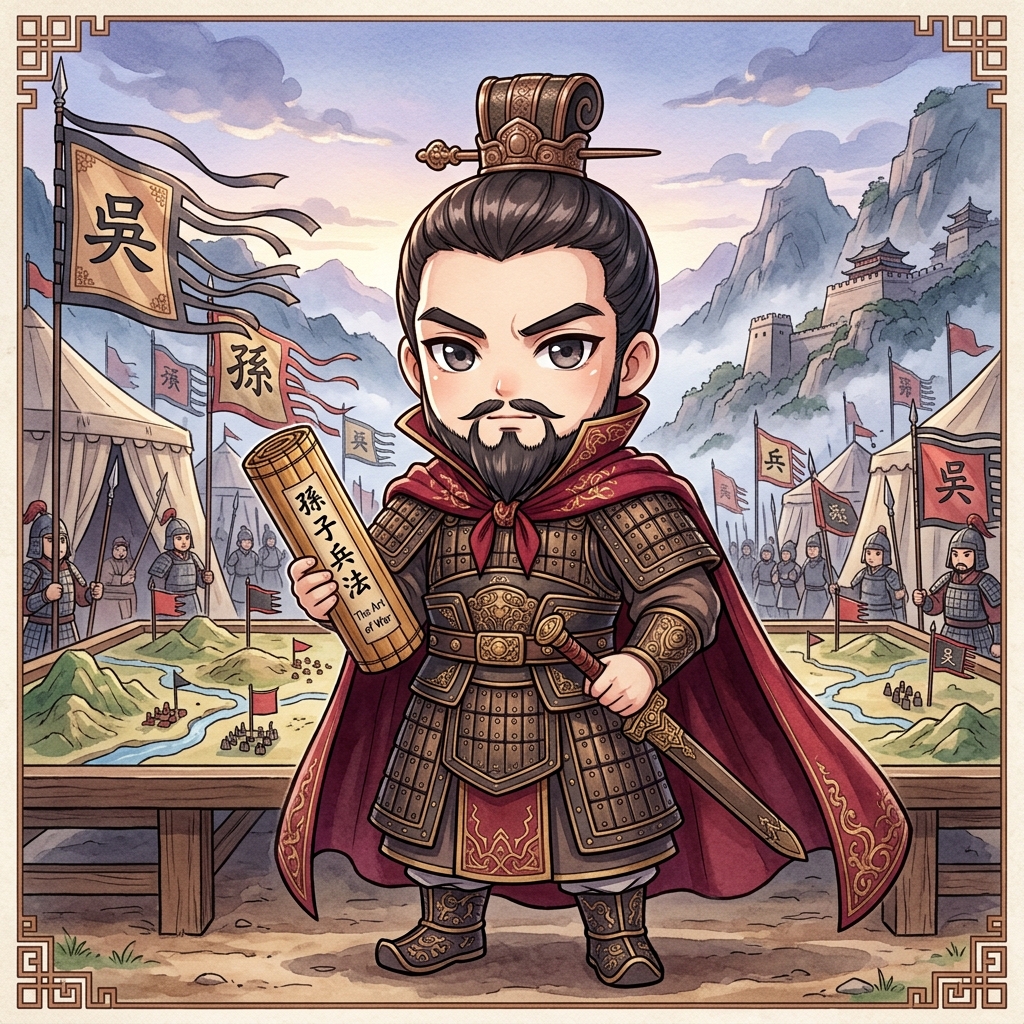
Sun Tzu (孙子) — The Supreme Strategist & Master of The Art of War
Dynasty: Spring & Autumn (c. 544 - 470 BCE)
Transformed warfare into an immortal philosophy of psychology and effortless victory.
Life Footprint & Journey Nodes
Le'an, Qi State (Huimin, Shandong) (山东惠民 (齐国乐安)) - Age 19
Sun Tzu's ancestral homeland on the Yellow River, Binzhou, Shandong
Born into an Aristocratic Clan of Military Thinkers
Born into the noble Tian (Sun) clan in the State of Qi. Immersed in classical military treatises from childhood, Sun Wu analyzed interstate politics and the psychology of power.
Military action is of vital importance to the State; it is a matter of life and death, a road either to safety or to ruin. Hence it is a subject of inquiry which can on no account be neglected.
兵者,国之大事,死生之地,存亡之道,不可不察也。 (Bīng zhě, guó zhī dà shì, sǐ shēng zhī dì, cún wáng zhī dào, bù kě bù chá yě.)Mount Qionglong, Wu State (Suzhou, Jiangsu) (江苏苏州 (穹窿山隐居著书)) - Age 26
Tranquil mountain retreat where Sun Tzu authored the thirteen chapters of The Art of War, Suzhou
Retreating to a Mountain Hut to Pen the Thirteen Chapters
Escaping civil unrest in Qi, Sun Wu traveled south to the State of Wu. Living as a recluse on Mount Qionglong, he synthesized ancient tactics into the thirteen immortal chapters of The Art of War.
If you know the enemy and know yourself, you need not fear the result of a hundred battles.
知彼知己,百战不殆;不知彼而知己,一胜一负;不知彼不知己,每战必殆。 (Zhī bǐ zhī jǐ, bǎi zhàn bù dài; bù zhī bǐ ér zhī jǐ, yī shèng yī fù; bù zhī bǐ bù zhī jǐ, měi zhàn bì dài.)Wu Royal Palace, Gusu (Suzhou, Jiangsu) (江苏苏州 (吴宫演兵与拜大将)) - Age 32
Wu royal court in Suzhou where Sun Tzu demonstrated military discipline
Drilling Royal Concubines to Prove Iron Discipline
Recommended seven times by Wu Zixu, Sun Wu presented his treatises to King Helü. When tested with drilling 180 court ladies, he strictly enforced military law, earning supreme command of the Wu military.
To fight and conquer in all your battles is not supreme excellence; supreme excellence consists in breaking the enemy's resistance without fighting.
百战百胜,非善之善者也;不战而屈人之兵,善之善者也。 (Bǎi zhàn bǎi shèng, fēi shàn zhī shàn zhě yě; bù zhàn ér qū rén zhī bīng, shàn zhī shàn zhě yě.)Baiju Battlefield, Hubei (Macheng) (湖北麻城 (柏举决战千里奇袭)) - Age 38
Fabled battlefield where Wu defeated Chu with asymmetric warfare, modern Macheng, Hubei
Five Battles, Five Victories: The Masterclass of Asymmetric Blitz
Appointed supreme commander alongside King Helü, Sun Tzu bypassed fortified rivers, marched thousands of kilometers, and defeated the massive Chu army at Baiju in five consecutive decisive engagements.
Let your rapidity be that of the wind, your compactness that of the forest. In raiding and plundering be like fire, in immovability like a mountain.
故其疾如风,其徐如林,侵掠如火,不动如山,难知如阴,动如雷震。 (Gù qí jí rú fēng, qí xú rú lín, qīn lüè rú huǒ, bù dòng rú shān, nán zhī rú yīn, dòng rú léi zhèn.)Yingdu Capital, Chu State (Jingzhou, Hubei) (湖北荆州 (攻入楚国都城郢都)) - Age 38
Capital of Chu state on the middle Yangtze captured by Sun Tzu, modern Jingzhou, Hubei
Entering the Capital of the Southern Superpower
The Wu forces captured Yingdu, the capital of Chu. Sun Tzu enforced strict discipline, preserved key civic institutions, and elevated the State of Wu to the pinnacle of interstate prestige.
Military tactics are like unto water; for water in its natural course runs away from high places and hastens downwards. So in war, the way is to avoid what is strong and to strike at what is weak.
夫兵形象水,水之形,避高而趋下;兵之形,避实而击虚。 (Fū bīng xíng xiàng shuǐ, shuǐ zhī xíng, bì gāo ér qū xià; bīng zhī xíng, bì shí ér jī xū.)Gusu Capital (Suzhou, Jiangsu) (江苏苏州 (筑城强国与称霸诸侯)) - Age 48
Ancient Wu capital & canal city of water gardens, modern Suzhou, Jiangsu
Designing the Great City of Gusu and Securing Hegemony
Returning victorious to Wu, Sun Tzu worked with Wu Zixu to design the massive stone walls and water canal system of Gusu, helping King Helü establish undisputed hegemony in East Asia.
The skillful tactician positions himself where he cannot easily suffer defeat, and misses no opportunity to defeat the enemy.
故善战者,立于不败之地,而不失敌之败也。 (Gù shàn zhàn zhě, lì yú bù bài zhī dì, ér bù shī dí zhī bài yě.)Dongting Mountain, Lake Tai (Suzhou, Jiangsu) (江苏太湖 (洞庭山超然隐退)) - Age 60
Misty hermitage slopes near Lake Taihu where Sun Tzu retired from politics, Suzhou
Walking Away from Power: The Ultimate Wisdom of Self-Preservation
Following King Helü's death, his successor Fuchai turned arrogant and executed Wu Zixu. Recognizing the tragic inevitability of court intrigue, Sun Tzu renounced all titles and retired to the tranquil waters of Lake Tai.
O divine art of subtlety and secrecy! Through you we learn to be invisible, through you inaudible; and hence we're the directors of the enemy's fate.
微乎微乎,至于无形;神乎神乎,至于无声,故能为敌之司命。 (Wēi hū wēi hū, zhì yú wú xíng; shén hū shén hū, zhì yú wú shēng, gù néng wéi dí zhī sī mìng.)Wuzhong, Suzhou (Jiangsu) (江苏苏州 (兵圣千古与百世流芳)) - Age 74
Historic southern Jiangsu sanctuary where the legacy of The Art of War became immortal
The Thirteen Chapters that Conquered Two and a Half Millennia
Sun Tzu passed away peacefully in Wu. His thirteen chapters survived dynasties, translated into hundreds of languages, revered across the globe as the foundational philosophy of strategy.
Place your army in deadly peril, and it will survive; plunge it into desperate straits, and it will come off in safety.
投之亡地然后存,陷之死地然后生。 (Tóu zhī wáng dì rán hòu cún, xiàn zhī sǐ dì rán hòu shēng.)
In-Depth Essays & Philosophical Inquiries on Sun Tzu
Browse All Classical Wisdom Essays in Directory
- Sun Tzu's Art of War: 5 Strategic Rules for Business Leadership
Learn how ancient strategic doctrines from Sun Tzu's Art of War translate into modern corporate decision-making, competitive agility, and leadership.
- Real Sun Tzu Quotes vs. Internet Fakes: The Art of War Debunked
Separate authentic wisdom in Sun Tzu's Art of War from widespread internet misattributions and discover what the master strategist actually wrote.