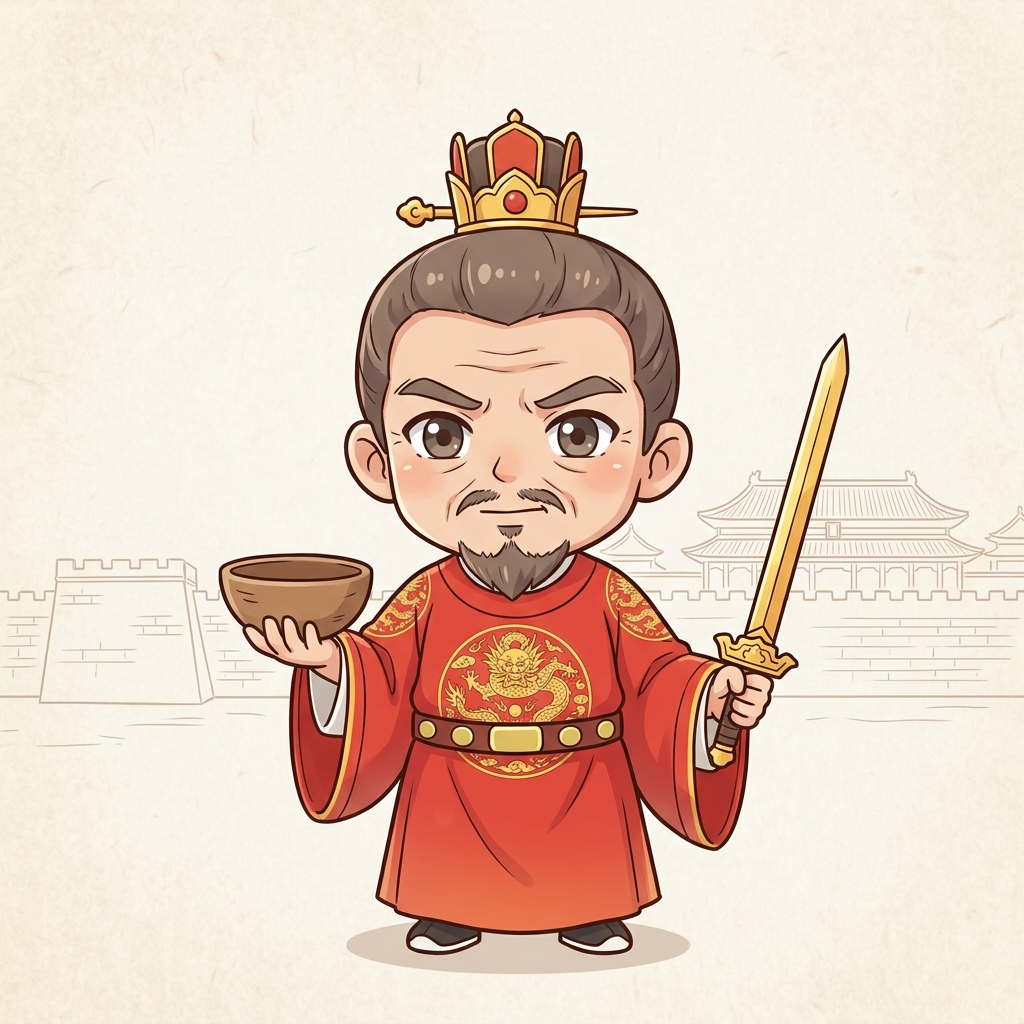
Zhu Yuanzhang (朱元璋) — The Commoner Who Founded the Ming Empire
Dynasty: Ming Dynasty
From a destitute monk and beggar to the supreme founding emperor of China.
Life Footprint & Journey Nodes
Haozhou (Zhongli, Birthplace) (濠州钟离(幼年奇穷)) - Age 1
Modern Fengyang County, Anhui Province
Born to tenant peasants during catastrophic famines, plagues claimed his parents and siblings, forcing him to bury them wrapped in ragged straw.
In 1344, terrible droughts and plagues swept the Huai River valley. Within weeks, young Zhu lost his father, mother, and eldest brother. Penniless, he begged neighbor Liu Jizu for a plot of barren soil to bury his family. This harrowing trauma forged his lifelong hatred of administrative corruption.
When hundred flowers bloom I wait in silence; when I bloom, the world shall tremble! I shall wage a battle against the autumn gale, clad from head to foot in golden armor.
百花发时我不发,我若发时都吓杀。要与西风战一场,遍身穿就黄金甲。 (Bǎi huā fā shí wǒ bù fā, wǒ ruò fā shí dōu xià shā. Yào yǔ xī fēng zhàn yī chǎng, biàn shēn chuān jiù huáng jīn jiǎ.)Huangjue Monastery (Alms Trail) (皇觉寺(出家托钵,浪迹淮西)) - Age 16
Fengyang, Anhui to Central China plains
Ordained as a novice monk, starvation soon forced him into a three-year wandering pilgrimage begging for alms across the Huai River basin.
Forced onto the roads with only an alms bowl, the teenage novice walked hundreds of miles across Anhui and Henan. Sleeping in ruined shrines and enduring hunger, this three-year wandering hardened his body, taught him grassroots human nature, and etched Central China's geography into his mind.
He began with nothing but a beggar's bowl, and ended by delivering all under Heaven from chaos.
开局一个碗,扫平天下乱。 (Kāi jú yī gè wǎn, sǎo píng tiān xià luàn.)Haozhou Garrison (The Righteous Army) (濠州城(投奔红巾,崭露头角)) - Age 24
Linhuai Town, Fengyang, Anhui
Responding to a secret summons, he enlisted in Guo Zixing's Red Turban uprising, earning renown for tactical brilliance and marrying the future Empress Ma.
Enlisting at the Haozhou rebel camp, Commander Guo Zixing was impressed by Zhu's commanding presence and tactical astuteness. Zhu proved fearless in combat, sharing all plunder with comrades. Guo gave him his foster daughter, Lady Ma, in marriage, while Zhu recruited loyal comrades including Xu Da and Chang Yuchun.
The reunification of all under Heaven begins today.
天下一统,当在今日。 (Tiān xià yī tǒng, dāng zài jīn rì.)Yingtianfu (Nanjing, Foundation of Ming) (应天府(高筑墙,广积粮,缓称王)) - Age 28
Modern Nanjing, Jiangsu Province
Capturing Nanjing, he embraced scholar Zhu Sheng's nine-word strategy: 'Build high walls, store abundant grain, and delay claiming kingship'.
Taking the historic metropolis of Nanjing in 1356, Zhu refrained from premature imperial declarations. He focused on revitalizing agriculture, enforcing civil discipline, and enlisting brilliant scholars including Liu Bowen and Song Lian to craft a stable institutional blueprint.
Build high walls, store abundant grain, and delay claiming kingship.
高筑墙,广积粮,缓称王。 (Gāo zhù qiáng, guǎng jī liáng, huǎn chēng wáng.)Lake Poyang (Naval Battle of Destiny) (鄱阳湖(火攻巨舰,水战克敌)) - Age 35
Northern Jiangxi, near modern Jiujiang / Poyang
Locked in a thirty-six-day titanic naval clash against Chen Youliang's colossal fleet, Zhu deployed fire-ships to annihilate his supreme rival.
Chen Youliang commanded towering three-story war fortresses bound together in floating formations. Strategist Liu Bowen identified shifting winds, and Zhu launched seven blazing fire-ships into the center of Chen's armada. The fire obliterated the fleet, establishing Zhu as the undisputed master of southern China.
The regal aura of Jinling rises sublime; a single battle settles the sovereign destiny of China.
金陵王气正巍巍,一箭射落江山定。 (Jīn líng wáng qì zhèng wēi wēi, yī jiàn shè luò jiāng shān dìng.)Nanjing Imperial Palace (The Hongwu Era) (南京皇宫(称帝改元,驱逐胡虏)) - Age 40
Nanjing Imperial Palace ruins, Jiangsu Province
Ascending the dragon throne in Nanjing to proclaim the Great Ming, he dispatched General Xu Da northward to retake Beijing and restore Chinese sovereignty.
On Chinese New Year in 1368, Zhu Yuanzhang declared the Ming Dynasty with the reign title Hongwu (Vast Martial Virtue). His northern manifesto declared: 'Drive out the foreign oppressors, restore China, and establish justice for the people.' General Xu Da recaptured Dadu (Beijing), reuniting China under domestic rule.
Drive out the foreign oppressors, restore China, establish legal order, and deliver the people from suffering.
驱逐胡虏,恢复中华,立纲陈纪,救济斯民。 (Qū zhú hú lǔ, huī fù zhōng huá, lì gāng chén jì, jiù jì sī mín.)Ming Xiaoling Mausoleum (Zijin Mountain) (明孝陵(钟山之巅,布衣天子长眠)) - Age 70
Mount Zijin, Nanjing, Jiangsu Province
Passing away in the imperial palace, he was laid to rest beside beloved Empress Ma at Ming Xiaoling, commanding that grief not disrupt commoners' lives.
In 1398, after 31 years on the throne, Zhu Yuanzhang died peacefully. He had eradicated corruption with iron discipline, conducted comprehensive land and population censuses, and revived agriculture. His final testament ordered that mourning not interfere with farming or marriages, honoring his peasant roots to the end.
For thirty-one years, conscious of perils day and night, I labored tirelessly for the empire. Now, obeying Heaven's mandate, I return peacefully to nature.
三十一年,忧危积心,日勤不怠。今兹眷命,归于自然。 (Sān shí yī nián, yōu wēi jī xīn, rì qín bù dài.)
In-Depth Essays & Philosophical Inquiries on Zhu Yuanzhang
Browse All Classical Wisdom Essays in Directory
- Who Was Zhu Yuanzhang? The Beggar-Monk Who Founded the Ming Dynasty
Who was Zhu Yuanzhang? The orphaned monk who expelled Yuan rule, founded Ming, and governed as the Hongwu Emperor with legendary severity.