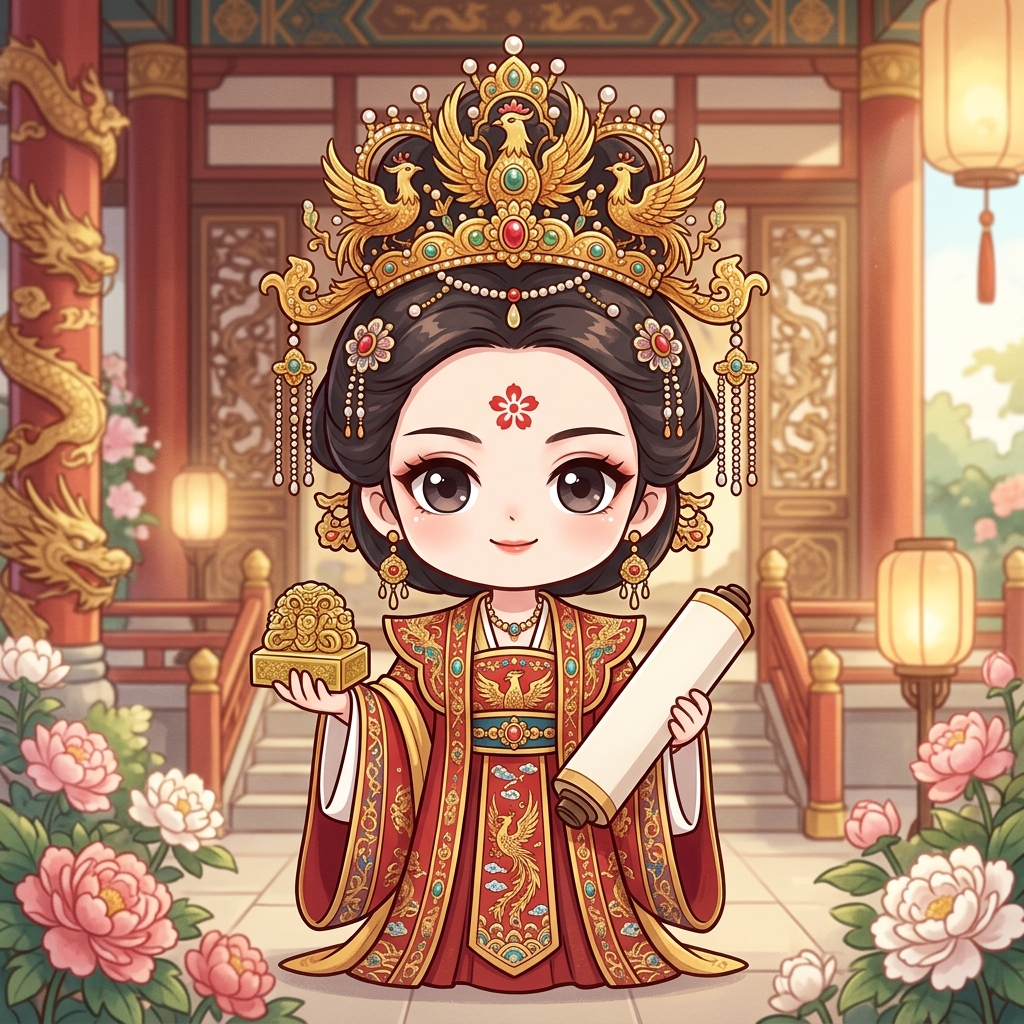
Wu Zetian (武则天) — The Only Female Sovereign of Imperial China
Dynasty: Tang & Zhou Dynasties
From Imperial Concubine to Supreme Sovereign: The Iron Empress of the Golden Tang.
Life Footprint & Journey Nodes
Lizhou (Disputed Birthplace) (利州(出生地存疑)) - Age 1
Near modern Guangyuan, northern Sichuan Province
Born into the aristocratic Wu clan in northern Sichuan, her early childhood was steeped in courage, literacy, and boundless curiosity.
Her father, a timber magnate who backed the founding of the Tang Dynasty, served as governor of Lizhou. Her mother was of noble Sui imperial lineage. Growing up immersed in historical chronicles and strategic literature rather than traditional needlework, she developed an audacious vision rare for women of her era.
Seeing crimson turn to azure amidst swirling thoughts, haggard and worn with longing for you.
看朱成碧思纷纷,憔悴支离为忆君。 (Kàn zhū chéng bì sī fēn fēn, qiáo cuì zhī lí wèi yì jūn.)Chang'an (Imperial Capital of Tang) (长安(唐都城)) - Age 13
Modern Xi'an, Shaanxi Province
Entering the Forbidden City at fourteen, she evolved from a humble consort to co-ruling alongside Emperor Gaozong as the 'Two Sages'.
Legend records her offering to tame a wild imperial steed with a whip, a hammer, and a dagger—revealing her unflinching resolve even in youth. After returning to court as Empress, she actively steered imperial statecraft during Emperor Gaozong's chronic illness, establishing agricultural reforms and merit-based promotions.
Tomorrow I shall tour the imperial park; herald spring with haste! Let all flowers blossom overnight, wait not for the morning breeze.
明朝游上苑,火急报春知。花须连夜发,莫待晓风吹。 (Míng zhāo yóu shàng yuàn, huǒ jí bào chūn zhī. Huā xū lián yè fā, mò dài xiǎo fēng chuī.)Ganye Buddhist Temple (感业寺(幽居削发)) - Age 25
Within historical Chang'an (modern Xi'an, Shaanxi)
Exiled to a Buddhist convent upon Emperor Taizong's death, she endured the darkness with poetic grace until destiny reopened its doors.
Under strict imperial etiquette, childless consorts of deceased emperors were condemned to spend their remaining lives as Buddhist nuns. Rather than withering away, she kept her intellect sharp and composed 'Ru Yi Niang', an evocative verse of love and yearning that moved Emperor Gaozong to bring her back to court.
If you believe not in the tears shed in sorrowful exile, open the chest and examine my pomegranate-dyed silk gown.
不信比来常下泪,开箱验取石榴裙。 (Bù xìn bǐ lái cháng xià lèi, kāi xiāng yàn qǔ shí liu qún.)Luoyang (Divine Capital of Zhou) (洛阳(东都 / 神都)) - Age 60
Modern Luoyang, Henan Province
Proclaiming Luoyang as the Divine Capital, she founded the Great Zhou Empire—shattering millennia of patriarchal tradition to rule as Emperor.
In 690 CE, Wu Zetian ascended the throne at the Ze Tian Gate, inaugurating the Zhou Dynasty. She personally created the palace examination system (Dianshi) and military exams, enabling commoner talents to bypass aristocratic monopolies. Her administration fostered agriculture, secured frontier defenses, and stabilized the realm.
Great radiance fills the world, universal harmony embraces the seas. High Heaven looks down with grace to establish our imperial foundation.
天下光宅,海内雍熙。上玄降鉴,方建隆基。 (Tiān xià guāng zhái, hǎi nèi yōng xī. Shàng xuán jiàng jiàn, fāng jiàn lóng jī.)Mount Song (Central Sacred Peak) (嵩山(封禅天册)) - Age 72
Modern Dengfeng, Henan Province
Ascending the Central Sacred Peak to perform the ancient Feng Shan rituals, she consecrated her imperial authority between Heaven and Earth.
Historically reserved exclusively for legendary male monarchs, the Feng Shan ceremony was celebrated by Wu Zetian at Mount Song in 696 CE. She presented golden tally slips asking for divine protection over the empire and universal prosperity, confirming her sovereign legacy through sacred classical rites.
Right and wrong, triumphs and faults—Heaven and Earth bear witness to all.
是非功过,天地昭然。 (Shì fēi gōng guò, tiān dì zhāo rán.)Shangyang Palace (Luoyang) (洛阳上阳宫(仙居归宁)) - Age 81
Imperial gardens in modern Luoyang, Henan Province
Relinquishing power with calm dignity after the Shenlong Coup, she retired to Shangyang Palace, bringing a peaceful conclusion to her dynasty.
When senior statesmen led the Shenlong Coup of 705 CE to restore the Tang imperial house, the ailing 81-year-old sovereign accepted the transition with stateswomanly wisdom. Her final decree surrendered the title of Emperor to avoid civil war, requesting burial as Empress beside her late husband Gaozong.
Relinquish the imperial title of Emperor, address me as Empress Zetian Dasheng, and bury me alongside Emperor Gaozong at Qianling.
去帝号,称则天大圣皇后,祔葬乾陵。 (Qù dì hào, chēng Zé Tiān Dà Shèng Huáng Hòu, fù zàng Qián Líng.)Qianling Imperial Mausoleum (乾陵(无字碑前,天地自知)) - Age 82
Modern Qian County, Xianyang, Shaanxi Province
Laid to rest at Qianling, she erected the iconic Wordless Stele—leaving her monumental legacy for future generations to evaluate without vanity.
Standing 7.5 meters high and carved from a single monolithic limestone block, the Wordless Stele is adorned with eight coiling dragons but bears not a single inscribed character. In a culture saturated with hyperbolic eulogies, her deliberate silence stands as the ultimate act of self-confidence: true history speaks through results, not carved self-praise.
My triumphs and errors, gains and losses—leave them unwritten, that future generations may freely judge.
己之功过,是非得失,不着一字,留待后人。 (Jǐ zhī gōng guò, shì fēi dé shī, bù zhuó yí zì, liú dài hòu rén.)
In-Depth Essays & Philosophical Inquiries on Wu Zetian
Browse All Classical Wisdom Essays in Directory
- Who Was Wu Zetian? China's Only Female Emperor and the Politics of Legitimacy
Who was Wu Zetian? China's only female emperor—rise from Tang consort to sovereign, reforms and ruthlessness, and why her legacy stays contested.